China, Venezuela, Climate Change: Your Thursday Briefing - The New York Times

(Want to get this briefing by email? Here's the sign-up.)

Good morning.

China has a sweeping vision for its remote steppes, Venezuela's president offers to negotiate, and President Trump feuds with his intelligence chiefs. Here's the latest:

The barely inhabited steppes of Central Asia — near the one point on earth farthest from a sea or ocean — are in for a transmogrification.

The Chinese government has decided to shape the region that straddles its border with Kazakhstan into the control center of its vast, trillion-dollar Belt and Road Initiative. A village there named Khorgos, which its boosters say is poised to become the next Dubai, will soon be the world's largest dry port — an inland shipping and logistics hub.

Background: Beijing has embarked on a mammoth project to link China to the rest of Asia, the Middle East, Africa, Russia and Europe with a latticed network of trains, highways and shipping corridors. Critics have described it as "debt trap" diplomacy and a new kind of colonialism.

One sticking point: Beijing's detention of hundreds of thousands of Uighur, Kazakhs and other minorities in internment camps in the nearby Xinjiang region has not helped its standing with the Kazakh government.

As protests broke out in Venezuela again, President Nicolás Maduro said he was open to sitting down with the opposition, but it was unclear whether the offer was genuine or just a delaying tactic.

In an interview with a Russian news agency, Mr. Maduro also rejected calls for a new election. His re-election last year has been widely disputed, and the U.S. and a number of European countries have called for a fresh vote.

In a video, Mr. Maduro warned the U.S. that military intervention in his country "would lead to a Vietnam worse than they can imagine."

Background: Over the last week, Juan Guaidó, the leader of the opposition, has received growing recognition around the world as interim president. The U.S., in an effort to oust Mr. Maduro, has imposed harsh oil sanctions that economists worry could unravel a Venezuelan economy already in vertiginous decline.

On the streets: Mr. Maduro has hit back viciously, human rights groups and others say, dispatching security forces to crush dissent in poor neighborhoods that have turned on his government. The deadly operations have alarmed even some of the president's traditional supporters. And his reliance on a special police unit — relatively new and shrouded in secrecy — may be a sign of disarray and waning loyalty in the military.

Another angle: Russia has been supporting Mr. Maduro from the sidelines and directing opprobrium at the U.S. It is unlikely to do more than that, our Moscow bureau chief writes.

In Opinion: Mr. Guaidó compares the movement he is leading against Mr. Maduro to the uprising that unseated the Venezuelan dictator Marcos Pérez Jiménez in 1958, and writes that "the military's withdrawal of support from Mr. Maduro is crucial to enabling a change in government."


Unnerved by fears of a rushed American deal with Taliban insurgents, President Ashraf Ghani of Afghanistan sent a letter to President Trump offering to lower the costs of keeping U.S. troops in the country. The letter suggested reducing the number of American troops to as few as 3,000.

Context: U.S. diplomats and Taliban representatives both say they have made significant progress in peace talks that offer a path for America's withdrawal from Afghanistan. But the Afghan government has been left out of the loop, frustrating Mr. Ghani. Afghan officials say they see their worst fear coming to pass — a Trump administration with little regard for what withdrawal means for Afghanistan's 35 million people.

But many members of the Afghan political elite support an American exit, isolating Mr. Ghani.


A new study has found that rising ocean temperatures correlate with the widespread deaths of the sunflower star, a species of starfish native to the Pacific Ocean.

Details: From 2013 to 2015, the Pacific became unusually warm. At the same time, millions of starfish started succumbing to a wasting disease. The study found that there was a correlation between the two events.

Background: The ocean, which absorbs 90 percent of atmospheric heat trapped by greenhouse gases, has been warming faster than previously thought, which in turn is killing off marine ecosystems, raising sea levels and creating more extreme weather patterns.

U.S.-Mexico border: A Times correspondent and photographer are on the 19th day of their drive along the roughly 1,900-mile border between the U.S. and Mexico. In the remote, tiny Mexican town of Boquillas del Carmen, they found tourism had dried up because of the partial government shutdown that, at least temporarily, just ended.

The Netherlands: A church's nonstop 96-day service came to an end after its organizers received confirmation from the government that a family of refugees sheltering inside the church would no longer face immediate deportation from the Netherlands — although their fate remains in limbo.

Brexit: The stickiest wicket is the so-called Irish backstop, a scheme for averting a physical border ever falling in Northern Ireland. The problem may not have a solution. Meanwhile, Parliament is looking worse for wear after this week giving Prime Minister Theresa May a mandate to do what is likely impossible: renegotiate her plan with the E.U. If Britain crashes out without a deal, food retailers warn they'll be the first to feel it.

E.U.: The churning chaos of Brexit has brought member states closer together and widely silenced populists who had only recently been calling for their own countries to leave the union.

The first pairing of "polar" and "vortex" is widely credited to an article published in 1853, in a magazine Charles Dickens edited. The author, John Capper, was a merchant and journalist who lived in what's now Sri Lanka.

His article, "Air Maps," was a somewhat florid account of the state of the relatively new science regarding wind, a crucial factor for nautical travel and trade in the era before marine engines.

The patterns of the Earth's major winds could be tracked, Capper wrote, and one "whirled about the pole in a continued circular gale: at last, reaching the great polar vortex."

These days, we know the polar vortex as those swirling winds breaking out of the polar region, bringing frigid temperatures south.

James K. Williamson wrote today's Back Story.


Your Morning Briefing is published weekday mornings.

Check out this page to find a Morning Briefing for your region. (In addition to our European edition, we have Australian, Asian and U.S. editions.)

Sign up here to receive an Evening Briefing on U.S. weeknights, and here's our full range of free newsletters.

What would you like to see here? Contact us at europebriefing@nytimes.com.

Howard Schultz May Be Even More Disingenuous Than Donald Trump - New York Magazine

At least he's bringing people together. Photo: JASON REDMOND/AFP/Getty Images

Most weeks, New York Magazine writer-at-large Frank Rich speaks with contributor Alex Carp about the biggest stories in politics and culture. Today, Howard Schultz's bid for the White House, what to expect in Stacey Abrams's State of the Union response, and two more insider accounts of Trump's path to the White House.

Since former Starbucks CEO Howard Schultz announced that he's interested in a "centrist independent" run for the White House, he's been the target of criticism everywhere from the White House to his own book signing. Is there no room for a centrist in the race, or is he just the wrong one?

Sometimes I wonder if there is such a thing as "centrism" in our politics anymore beyond its use as a branding strategy for pundits and out-of-work politicians hustling to be hired as talking heads. As Margaret Sullivan of the Washington Post wrote this week in response to CNN's hiring of John Kasich and CBS's of Jeff Flake, networks love the television-news equivalent of elevator music — "the smarmy centrism that often benefits nobody" but "won't offend anyone." Yet along comes Howard Schultz to prove that even in these polarized times, Americans from Donald Trump to Alexandria Ocasio-Cortez can still rally in the center in support of a shared conviction: Schultz's potential third-party presidential candidacy is a ludicrous exercise in plutocratic ego that is of benefit to no one except Trump.

So let's give Schultz credit for bringing the country together, even if only in its bipartisan detestation of him. And let's not fault Schultz for having zero qualifications for the White House now that Trump has obliterated the notion that qualifications are required. Still, Schultz's inadequacy for the presidency is more galling than Trump's. The incumbent charlatan-in-chief is nothing if not unabashed in advertising his moral unfitness, parading his ignorance, and spewing his contempt for democracy at every opportunity. Schultz, by contrast, is a fount of disingenuousness, wrapping his entitlement and narcissism in the cloak of high-minded ideals and furrowed-brow civic concern. Some will recall that his idea of solving America's racial woes the year before Trump's election was to have Starbucks baristas write "Race Together" on his customers' coffee cups — a scheme that he purported would generate conversation and reconciliation but whose only real point was to trigger an ad campaign intended to boost Starbucks sales and float Schultz's political ambitions. In the same vein, Starbucks rolled out a voter participation drive in 2016. "It's not just about who will be the next occupant of the White House," Schultz preached at the time. "More Americans should participate in all elections, even those for city councils and school boards." This week the Seattle Times reported that since 2005, Schultz voted in only 11 out of 38 elections.

Unlike Trump, Schultz did make rather than inherit his billions. (And also unlike Trump, Schultz actually can prove he has his billions.) But in his own way he seems almost as ignorant as Trump about politics. A self-described "lifelong Democrat," he says he is not running as a Democrat because the party has no place for centrists like him — which may come as news to Joe Biden, Michael Bloomberg, Beto O'Rourke, and John Hickenlooper, among others contemplating presidential candidacies. Schultz also seems to think there's a majority of America that shares his alienation from both political parties, when in fact Pew polling shows that only 18 percent of Americans have an unfavorable view of both parties and only 16 percent share Schultz's view that both are "too extreme." For that matter, he doesn't know that the polling term "Independent" refers not to "moderates" or "centrists" but to unaffiliated voters who are quite partisan, whether left or right. But why should he worry? The Washington Post reports that Schultz has been promiscuous in hiring pollsters and strategists (including the former Obama hand Bill Burton and the former McCain-ite Steve Schmidt), all of whom are happy to take his money and reassure him that he knows what he's talking about.

No third-party candidate can win the presidency, even if he's Theodore Roosevelt. All Schultz can do is siphon votes away from the Democratic ticket, much as Jill Stein did in 2016. Stein, we now know, was a useful idiot for the Russians in their scheme to help facilitate Trump's victory. Schultz may be less innocent. In recent years, Starbucks has been making deals in Russia, where its outlets have proliferated. For all we know, there was a plan to place a Starbucks in Trump's ill-fated Moscow Trump Tower to match the one in Trump Tower on Fifth Avenue. Time for another Steele dossier!

The Democrats have tapped Georgia's Stacey Abrams to respond to Trump's State of the Union next week. What's on the line for Abrams, and for Trump, in this rescheduled address?

Abrams is, along with O'Rourke and Florida's Andrew Gillum, a Democratic politician who found national stardom by losing a red-to-purplish state race in 2018. She lost the governorship narrowly to a Georgia secretary of State with a history of hostility to minority voting rights. Her popularity at home remains high, and it's possible she could defeat the man who beat her, Brian Kemp, in 2022, or perhaps knock out the freshman Republican senator David Purdue when he's up in 2020. On State of the Union night, her No. 1 mission must be not to make a fool of herself in a role that has proved an embarrassment for the likes of Bobby Jindal, Tim Kaine, and Marco Rubio. (Does anyone even remember who responded to Trump last time? Joe Kennedy, a young Massachusetts congressman who came across so blandly that he managed to drain the luster out of his hallowed family name.) My advice to Abrams would be to keep it simple: Explain her party's border security and immigration policy with clarity, passion, brevity, and a sense of humor.

In his previous State of the Union, Trump droned on for 80 minutes, reading robotically from a teleprompter and promising those who had not fallen into a coma that he was shepherding "a new American moment" that would include a $1.5 trillion infrastructure plan. Since then, countless "infrastructure weeks" have come and gone under that bridge to nowhere. This time around, perhaps Trump will revert to full MAGA mode, railing on about the wall and threatening another shutdown and/or a declaration of a national emergency to get his way. Given that a large majority of Americans disapprove of both these tactics, and that most Americans really don't care about the wall, it's all so much stale hot air. Stacey Abrams's biggest problem may be that much of the audience will have fled by the time her big moment arrives.

Two new books recounting time spent in the Trump campaign and White House came out this week, written by Chris Christie and Cliff Sims. Is there still an appetite for these stories?

It's hard to tell. They're both instant best sellers but that's meaningless. So was Omarosa's tell-all of last summer, Unhinged, whose sales collapsed the second week, despite the considerable publicity boost of an avid Trump Twitter rampage much like the one he's been aiming at Sims and his book. Since then Omarosa seems to have vanished into a witness protection program. Christie and Sims could well follow her to oblivion, joining Trump's original press secretary, Sean Spicer, another White House memoirist who seems to have vanished into a black hole after a brief flurry of speculation that he might land a gig on Dancing With the Stars.

Meanwhile, a thought experiment: Can you imagine who in his or her right mind would listen to the audiobook of Christie's Let Me Finish — ten hours' worth, read by Christie himself? It makes me feel a little better about life that quite honestly I cannot.

Storing Health Records On Your Phone: Can Apple Live Up To Its Privacy Values? - NPR

Sam Cavaliere, a San Diego tech worker, considers himself in average health, though the 47-year-old admits, "I can always stand to lose a little weight." Like a lot of iPhone owners, he uses Apple's Health app to keep track of his weight, his exercise routines and how many steps he takes in a day.

Now the app is also storing his health records.

Enlarge this image

Hundreds of health care providers around the United States allow their patients to use Apple's Health app to store their medical records. Apple hide caption

toggle caption
Apple

Since last March, Apple has been rolling out a feature that allows people to store their medical records in its Health app. UC San Diego Health, where Cavaliere sees his doctors, is one of more than 200 health care providers around the United States using the health records feature.

Cavaliere travels a lot for work, and he likes to keep track of his blood pressure. He's able to do that using a special cuff linked to the Health app.

And he likes the convenience of having the app keep his medical records.

"When I go to the doctor, in addition to my records from there, I get my blood pressure results that I've taken myself," Cavaliere says. "And they can see that and compare it to what they're doing in the office so that they get a bigger picture than just the once or twice a year that I show up at the office."

The global health care industry is expected to reach $10 trillion by 2022. That's bigger than the economy of any country other than the United States and China. Amazon, Google and Microsoft are among the companies vying for a piece of that pie in areas such as retail pharmacies, using artificial intelligence for disease detection and healthy-living apps.

And so is Apple.

At a moment when iPhone sales have slowed and many analysts are wondering if Apple's best days of innovation are behind it, the company has been innovating and expanding its presence in health care. It's an area where the company's long-held privacy values may give it an edge over the competition — if it can hold up to the growing public scrutiny.

Putting health records into an app created by a big tech company requires trust. Those records could list medications taken, treatments for diseases and visits to mental health care providers. That's not the kind of information most people want an employer, advertiser or insurance company to see.

Apple CEO Tim Cook has been a vocal advocate for privacy rights. Most recently, he has spoken out against rival companies Google and Facebook for making money off user data to sell ads.

In an interview with NPR, Cook says acquiring user data to sell ads is something his company has avoided. "People will look at this and feel that they can trust Apple," he says. "That's a key part of anyone that you're working with on your health."

Cook says Apple's commitment to privacy isn't simply a marketing ploy. "It's not the way we look at it in terms of advantages," he says. "The reality is that I know for me, I want to do business with people that have my health data, people that I deeply trust."

Cavaliere, the San Diego tech worker, says Apple has managed to gain his trust. "I don't get fed advertisements for them, so I don't see them trying to monetize it," he says. Unlike with other companies, he says, "I feel comfortable with how [Apple's] doing it and what they're doing."

Dr. Chris Longhurst, UC San Diego Health's chief information officer, says Apple's strong privacy values made officials at the facility feel more at ease. "Nothing is more important than keeping the privacy of our patients' health information," he says.

Longhurst says the iPhone helps keep the data safe. "This data did not go into the cloud," he says. "It only resided on the user's device, is encrypted and is only accessible with user permission." Health records are also subject to strict federal privacy laws.

But Apple has far from a perfect track record when it comes to privacy. At a time of heightened scrutiny of all tech companies and their privacy records, the Wall Street Journal has found that several top health and fitness apps available for iPhones send personal information, such as data about heart rates and menstrual cycles, to Facebook.

Apple says those apps don't connect to health records. It says the apps were violating its rules and the developers must fix the problem; those that don't will be removed from the App Store. Importantly, users must give permission before an app can access their health records.

Longhurst says UC San Diego Health cautions patients to be careful. "There are potential risks," he says. "It is important that patients be informed so that they're not inadvertently sharing information with third parties they would not want to have this information."

UC San Diego Health and other providers say they're open to working with other companies besides Apple. They just need assurances that their patients' health records will be safe, secure and private — and not fodder for advertisers.

Why Apple’s Big Streaming Play Matters - The New York Times

Good morning.

(Here's the sign-up, if you don't already get California Today by email.)

Yesterday, Cupertino got the kind of fevered coverage usually reserved for the unveiling of Apple's latest gadget. But this time, the product wasn't a watch or a phone.

During the two-hour event at the Steve Jobs Theater on Apple's campus, the company's leaders detailed its plans to take on Hollywood by creating its own TV shows and documentaries. They also announced a news subscription service and a credit card.

Yes, big-name celebrities like Steven Spielberg, Oprah Winfrey and Reese Witherspoon were on hand for the spectacle. But tech watchers were also paying close attention because the announcements are part of a major shift for the Silicon Valley mammoth.

Here's what you need to know:

Why is this such a big deal?

Apple has spent a decade establishing its dominant place in consumers' pockets by getting them hooked on iPhones. But after years of record-breaking profits, phone sales are slowing and the company is facing intense competition from the likes of Amazon and Netflix.

So, instead of betting on another gadget, Apple made clear yesterday that it's "trying to make sure you never leave all those Apple devices you have acquired over the years," as my colleagues Daisuke Wakabayashi and John Koblin reported.

That means Apple is bulking up on content and services, and focusing less on hardware.

Not that there isn't a lot of Apple hardware already out there: The company counts roughly 1.4 billion active devices as the perfect vehicles for its new content.

What's this about more subscription services?

First, there was Apple TV Plus, the video streaming service, which will have original programs and will include shows from networks like HBO, Showtime and CBS. Beyond that, details were sparse. No price was given.

But, as my colleague Edmund Lee explained, one thing's for sure: You won't be able to get your favorite Netflix shows.

There was more on Apple News Plus, which was described as the "Netflix of news," but it also raised questions about Apple's place in an information ecosystem that's been brutal to existing publishers.

A subscription will cost $9.99 per month. It will let subscribers read 300 magazines as well as articles from newspapers including The Los Angeles Times and The Wall Street Journal.

Executives with The Journal said they'll hire new staff members to write content that's exclusive to the Apple app, which Bloomberg described as a risky move that could "cannibalize existing readership."

Neither The Times nor The Washington Post has signed on.

Apple also announced a video game subscription service, Apple Arcade, which is set to start this fall.

(We often link to sites that limit access for nonsubscribers. We appreciate your reading Times stories, but we'd also encourage you to support local news if you can.)

• At the heart of many Democrats' "Medicare for all" proposals is the idea that the country should sweep away the mess of a private health insurance system that we have. But that would also disrupt a vast industry that employs at least half a million people. Its companies' stocks are a staple of mutual funds that make up many Americans' retirement savings. [The New York Times]

• Michael Avenatti, the outspoken lawyer known for representing Stormy Daniels, burst into the news on Monday: He was arrested in New York for allegedly trying to extort Nike. And he was charged in a separate bank and wire fraud case in California. [The New York Times]

• The suburban community of Escondido was rattled when the police say someone started a fire at a mosque there and left a note referencing the New Zealand attacks. [NBC7]

• "It's always 'at least a couple months' from FEMA." Many Camp Fire victims are barely hanging on months after the blaze devastated their community, and they feel forgotten. [BuzzFeed News]

• Twelve people, including six coaches, pleaded not guilty to charges related to the college admissions scandal. But the investigation continues, leading to speculation more parents or coaches could be charged. [The New York Times]

• State Senator Scott Wiener and Daniel Kammen, a U.C. Berkeley professor of energy, argue that housing policy is also climate policy. [New York Times Opinion]

• An Escondido company is recalling avocado shipments to six states "out of an abundance of caution." Officials said the fruit may have been contaminated by listeria bacteria. [The New York Times]

• Traci Des Jardins, the chef who helped define fine dining in California, will end the more than two-decade run of her flagship restaurant, Jardinière, on April 27. She plans to focus on Mexican cuisine. [The New York Times]

• The Lakers definitely aren't in the playoffs. So what's the team doing? LeBron James hasn't played in games this inconsequential since his rookie season in Cleveland. But some young players are taking this as an opportunity to get in some reps and prove themselves. [The New York Times]

• Stanford's women's basketball team is headed to the Sweet 16 again. It beat B.Y.U. last night in the Cardinal's bid to make its eighth Final Four in 12 seasons. [The Mercury News]

• You can get 20 percent off the first week of San Francisco performances of "The Jungle," a play about migrants in Calais, using the code NYTEVENTS here. The play starts today, but on Friday, you'll see the show with Michael Paulson, a Times theater reporter, who will moderate a discussion.

What is the San Diego Zoo without its giant pandas? Californians are about to find out.

The bamboo-eating bears have been a consistent main attraction at the zoo for about a quarter of a century. But now, the last two pandas in its conservation program for the animals — a 27-year-old female, Bai Yun, and her son, 6-year-old Xiao Liwu — are set to be "repatriated to their ancestral homeland," China.

The zoo said that the move honors the terms of its loan agreement with the Chinese government. On its website, visitors were encouraged to say their goodbyes in Panda Canyon until April 27 and share their memories using the hashtag #pandas4ever.

Mercifully, this may not be the end of panda watch: The San Diego Union-Tribune reported that zoo officials were planning to go to China for in-person negotiations in hopes of bringing pandas back.

California Today goes live at 6:30 a.m. Pacific time weekdays. Tell us what you want to see: CAtoday@nytimes.com.

Jill Cowan grew up in Orange County, went to school at U.C. Berkeley and has reported all over the state, including the Bay Area, Bakersfield and Los Angeles — but she always wants to see more. Follow along here or on Twitter, @jillcowan.

California Today is edited by Julie Bloom, who grew up in Los Angeles and graduated from U.C. Berkeley.

A Sparkling Shrine to a Reviled Russian Leader - The New York Times

YEKATERINBURG, Russia — President Vladimir V. Putin of Russia has reviled those years as a period of chaos, crime and "total poverty" that "nobody wants to ever see return."

Kremlin-controlled news media outlets regularly lambast what they call "the wild 90s" as a time of personal humiliation and shameful national weakness.

All the abuse, however, has been an unexpected boon to the Boris Yeltsin Presidential Center, a shimmering shrine on the edge of Siberia to Mr. Putin's reviled predecessor and his turbulent years in power, from the 1991 collapse of the Soviet Union to the end of 1999.

"I am glad they are constantly criticizing the '90s," said Alexandr Drozdov, the executive director of a private foundation that oversees the Yeltsin center, a museum and archive complex dedicated to Russia's first elected and, at least according to opinion polls, widely loathed late president. "I tell them, 'Keep criticizing, please don't stop.' "

The torrents of scorn poured on Mr. Yeltsin and his era by the Kremlin's cheerleaders have given the complex an edgy appeal, helping it attract more than 700,000 visitors since it opened three winters ago.

It has become perhaps Russia's most popular and certainly its most lavishly equipped outpost of alternative history and against-the-grain thinking.

On the surface, the complex — set next to a lake in the center of Yekaterinburg, the industrial city where Mr. Yeltsin lived for much of his life and where Czar Nicholas II and his family were murdered by the Bolsheviks — is a showcase for how Russia has changed for the better under Mr. Putin.

It is shiny and modern, efficiently run and brimming with high-tech flourishes.

But at its core, the complex is a mournful requiem for the many things lost since Mr. Yeltsin stepped down on Dec. 31, 1999, and handed power to his chosen successor, Mr. Putin, with the words: "Take care of Russia."

Mr. Yeltsin, said Mr. Drozdov, "would be very disappointed" had he lived to see where Mr. Putin has taken the country. "He would cry."

One exhibit features puppets from a satirical television show that, in the 1990s, skewered Mr. Yeltsin and his officials mercilessly. The show was canceled by Mr. Putin, who took umbrage at his representation by an ugly, dwarfish puppet.

The once private television station that broadcast the weekly show, NTV, is now controlled by the state and serves as a bullhorn for Kremlin propaganda.

Western-oriented liberals mostly view Mr. Yeltsin as a brave, if deeply flawed, hero who rallied resistance to an August 1991 putsch by Communist Party hard-liners, broke the back of the Soviet Union, introduced capitalism and gave birth to Russia as a free and democratic nation.

Nationalists and leftists, though, remember him as at best a vodka-soaked buffoon and at worst a traitor working for the West.

They want the complex shut down, or at least altered to create what Ilya Belous, a noisy local critic, thinks should be "a museum of Yeltsin's crimes." (A Muslim cleric close to the Kremlin has suggested that it be simply blown up.)

"Putin's P.R. team has reduced everything to the contrast between images of a young, dynamic Putin and an old, alcoholic Yeltsin," said Yevgeny V. Roizman, a Kremlin critic who resigned last summer as the elected mayor of Yekaterinburg in protest at the abolition of mayoral elections in the city.

"Many people don't really know what happened in the 1990s," the former mayor said. "They simply don't understand what Yeltsin did and why."

"They blame Yeltsin for destroying the Soviet Union," he continued, "but nobody destroyed it. The Soviet Union fell apart of its own accord because it could not support itself ideologically or economically. It simply collapsed."

The center's goal, said Dina Sorokina, the museum director who is a graduate of New York University, is not to whitewash Mr. Yeltsin, though it does largely ignore some of the more odious features of his rule, notably the emergence of so-called oligarchs through corrupt privatization deals.

"The goal is not hagiography but an attempt to understand that time and also where we are now," she said.

The silence about Russia's oligarchs is perhaps explained by a list of donors at the entrance. It includes billionaire tycoons like Oleg Deripaska and Roman Abramovich, both of whom made their fortunes in the 1990s.

Also named as a donor, curiously, is Mr. Putin, who attended the opening of the museum, along with Mr. Yeltsin's widow, Naina.

In a stiff speech, Mr. Putin said the museum told "the honest story of what was done in a difficult time."

Mr. Drozdov recalled that the president strolled through exhibit halls celebrating lost freedoms "without a hint of emotion on his face."

"He was like a mummy," Mr. Drozdov said.

The Kremlin's blessing for the project, said Mr. Roizman, the former mayor, flowed from a contradiction at the heart of Mr. Putin's rule. While he has undone much of Mr. Yeltsin's legacy, particularly in politics, he came to power thanks to Mr. Yeltsin.

"Putin owes Yeltsin everything," Mr. Roizman said.

Mr. Putin, who has always placed a premium on loyalty, never attacks Mr. Yeltsin personally. But he has given state news media outlets free rein to attack his predecessor's legacy with gusto.

Mr. Yeltsin, who was born near Yekaterinburg and governed the city as Communist Party boss in the 1970s, died in 2007 at age 76.

But he still looms large in Russia, even if mostly as a punching bag for Mr. Putin's cheerleaders on state TV and as a hate figure for many ordinary Russians, who blame him for the demise of the Soviet empire and for plunging the country into poverty and disorder.

Mr. Putin often plays on public nostalgia for the Soviet Union and regularly boasts of ending the economic misery and political chaos of the 1990s. The center, though, offers a starkly different view of the past.

It greets visitors with an animated film celebrating Mr. Yeltsin as Russia's first leader in more than a millennium to break a grim cycle of bloody tyranny punctuated by brief spurts of failed reform.

In addition to the permanent exhibition feting Mr. Yeltsin and the freedoms he introduced, it also hosts seminars, debates and cultural events that stray far from the monochrome, muscular patriotism promoted by the Ministry of Culture in Moscow.

As Mr. Putin's rule, now already twice as long as Mr. Yeltsin's, drags on, grim memories of the 1990s are perhaps brightening a bit as faith in Russia's current course dips.

Nikita Shitov, a Yekaterinburg resident who set up a small business in the Yeltsin years and then watched rapacious officials destroy it after Mr. Putin came to power, said the 1990s were often chaotic "but the state did not crawl into our lives like it does now."

That the public is not entirely convinced by the image on state television of Mr. Putin as Russia's savior is clear in the often empty halls at a rival museum in Yekaterinburg, where an exhibition on "Russia: My History" gives a highly nationalistic recounting of the past.

It presents the 1990s as a period of unrelieved misery and Mr. Putin's time in office as an era of prosperity and national rebirth.

Despite being heavily promoted by state media outlets, the museum was empty of visitors last week except for schoolchildren on a field trip.

The most virulent critics of the Yeltsin complex have been grandstanding celebrities like Nikita Mikhalkov, a filmmaker who thrived under Mr. Yeltsin's presidency but has since recast himself as a great Russian patriot and Putin loyalist.

He has repeatedly demanded, so far without success, that the center, and a second Yeltsin museum under construction in central Moscow, be closed down so as to protect Russia from the former president's "poison."

The denunciations have only helped keep up public interest.

Andrei Pirashkov, a 23-year-old communist who was elected last year to the City Council in Yekaterinburg, said he was no fan of Mr. Yeltsin but often visited the center for its lively seminars and public debates.

"I am against making a personality cult around Yeltsin," Mr. Pirashkov said, "But the real issue now is Putin."

Funds: Investing in China's new economy - The Edge Markets MY

There are investing opportunities to be found as China transitions into its new economy despite the geopolitical and economic challenges that are currently plaguing the markets, according to Affin Hwang Asset Management Bhd (AHAM) managing director Teng Chee Wai.

This optimism stems from the reforms taken by the Chinese government to move away from an industrial-focused economy to a consumption and services-based one, which is boosted by the presence of internet players such as Alibaba Group Holding Ltd, Tencent Holdings Ltd and Baidu Inc.

"We believe there are ample opportunities in the Asian economic giant as the reforms take root. China's economic transition has led to the emergence of a new set of opportunities via the consumption and services-led sectors as the country moves away from high-speed growth and focuses more on quality growth. Positive demographic and consumption trends are also supportive of this view," says Teng.

The Chinese government is expected to undergo some monetary policy easing to cushion a slower-growth environment. Valuations are also at historical lows, which could offer attractive investment opportunities, even though there is moderating earnings growth.

"We have seen some softness in recent Chinese data, which shows that its manufacturing sector is experiencing a slowdown as a result of the trade conflict. The stimulus measures announced by Beijing to prop up growth and cushion the impact from its ongoing trade spat with the US have provided a reprieve for markets and inject liquidity," says Teng.

"Closer monitoring would be needed to see whether such stimulus has started to trickle down to growth and GDP, possibly sometime in 2Q2019 due to lag effects. Still, with a larger pain threshold and a more resilient economy today, we do not see China reverting to its more aggressive stimulus measures to drive growth, like its credit-fuelled binge in the past.

"Over the long term, as China presses on with reforms, we see positive structural trends that bode well for the country. Its consumption and services-led sectors now contribute more than 60% to GDP and growth is expected to increase exponentially with rising income levels and rapid urbanisation. As China continues to harness these strengths, we see opportunities emerging from the consumption and services-led sectors, which are riding these positive trends."

To take advantage of these opportunities, AHAM will be listing its TradePlus S&P New China Sector exchange-traded fund (ETF) on Jan 28. The ETF will track the S&P New China Sectors Ex A-Shares Index, which measures the performance of China and Hong Kong-based companies in the consumption and services-oriented industries. Offshore listings of all Chinese share classes can be included in the index, excluding A-shares.

The ETF will be the first to list on Bursa Malaysia in dual currencies (ringgit and US dollar), but it will not be the first to focus on China. The CIMB FTSE China 50 ETF was launched in 2010 to track the performance of the 50 largest and most liquid Chinese stocks listed and traded on the Hong Kong Stock Exchange. According to its fund fact sheet as at Dec 31, 2018, its largest holdings are financials (45.99%), telecommunications (18.89%) and energy (11.56%).

"The TradePlus S&P New China Sector ETF differentiates itself by participating in the beneficiaries of the Chinese government's initiatives for economic transition. This ETF will be shying away from the conventional heavy banking names, which typically make up the bulk of the general indices," says Chong Lee Choo,  AHAM's director of the Innovation Lab and alternative investments.

Instead, the ETF will give exposure to some of the fastest-growing internet companies that investors in Malaysia may not have easy access to, she adds. "These sectors are expected to benefit from the spending patterns of Chinese consumers. For instance, we saw record-breaking figures on Single's Day, which saw Alibaba rake in US$30.8 billion in sales within 24 hours."

The new economy, as tracked by some indices, has already outperformed the broader Chinese market, which is heavy on financial and industrial stocks. For instance, the S&P New China Sectors Ex A-Shares Index's three-year total returns outperformed those of the FTSE China 50 index by 9.74 percentage points and the Shanghai Stock Exchange Composite Index by 47.09 percentage points, according to Bloomberg data as at Dec 31, 2018.

"We believe that these sectors [consumption and services-oriented industries] will be the key beneficiaries of the government's focus on transitioning away from an industrial-focused economy. Despite the economy's marginally slower growth, shares of China's new economy have beaten the broader market," says Chong.

She cites the MasterCard Caixin BBD New Economy Index (NEI) as evidence of the growing importance of the new economy. The index, launched in March 2016, defines the new economy as industries that are labour and technology-intensive but asset light, experience sustainable, have rapid growth and are in strategic areas encouraged by the government.

"The NEI, which measures labour, capital and technology inputs in 10 emerging industries relative to those in all other industries, hit a new high last year. The new economy industries accounted for 31.33% of China's overall economic input activities," says Chong.

According to a Caixin report last December, the top contributor was the new information and technology sector, followed by financial and legal services and advanced equipment manufacturing.

The TradePlus S&P New China Sector ETF's annual management fee and annual trustee fee are up to 1% and 0.04% of the net asset value respectively. The ETF will be listed at HK$10 per unit, with the ringgit and US dollar value dependent on the foreign exchange rate on the day of listing. Investors will be required to purchase a minimum of 100 units.

The ETF gives Malaysian investors access to Chinese stocks listed in Hong Kong, China and even the US. "It will be a cost-efficient alternative for investors to gain access to a portfolio of companies that will be beneficiaries of China's new economy policies by trading in a single ETF, as opposed to individual stocks on the global market," says Chong.

She adds that the company plans to keep the tracking error low through a lower fee structure than a typical unit trust fund.

The new economy

Communications is one of the more influential sectors of China's new economy. According to the S&P New China Sectors Ex A-Shares Index fact sheet as at Dec 31, 2018, the sector is the biggest constituent (34.3%) of the index.

Some of the big names in this sector are Tencent and China Mobile Communications Corp, which are capitalising on the 772 million internet users and 717 million smartphone users in the country. This compares with the 292 million internet users and 226 million smartphone users in the US. This data, cited by Chong, is as at December 2017. "To date, China accounts for 19% of the entire planet's four billion internet users and 26% of the 2.8 billion smartphone owners," she says.

Meanwhile, the consumer discretionary sector is the second largest constituent (28.7%) of the index. The sector has benefited from technological improvements and the popularity of e-commerce.

In 2017, China was the largest e-commerce market in the world, despite online retail sales making up only 20% of total retail sales, says Chong. Some of the companies in this sector listed on the index include Alibaba, JD.com Inc and Galaxy Entertainment Group Ltd, according to the index fact sheet.

"On the financial industry front, the ETF will largely be investing in insurance-related names. Analyst reports show that China is on track to become the world's largest insurance market as it stands to benefit from the development of a burgeoning middle class, proliferation of major infrastructure projects and an increase in GDP," says Chong.

The financial sector is the third largest constituent (23.4%) of the index. It comprises companies such as AIA Group Ltd, Ping An Insurance (Group) Co of China Ltd and China Life Insurance Co Ltd. The two Chinese companies are known for their innovations in digitalising insurance services and using technologies such as artificial intelligence and blockchain.

"China's digital transition is likely to provide a boost [to this sector], with companies taking advantage of more innovative products and new distribution channels and putting in place more targeted marketing initiatives. We believe there is still strong growth potential in the industry, given that the penetration rate remains low at 4.4%, whereas the global average stands at 6.1%," says Chong.

The other sectors represented by the index are healthcare (4.9%), consumer staples (4.5%), industrial (3.1%), utilities (0.9%) and IT (0.2%).

Remaining risks

The launch of the TradePlus S&P New China Sector ETF comes amid many uncertainties in China that are expected to weigh on the minds of investors this year. Predictions of slowing economic growth and the US-China trade tensions are just some of the concerns impacting the outlook on Chinese equities.

"We find that the economic landscape has been changing rapidly. Coupled with the ongoing uncertainties, we believe that it has become a lot harder to answer the question of when is the best time to invest. We do not believe that investors should invest according to binary outcomes that cannot be predicted with any reasonable certainty, such as a trade deal or no-deal scenario," says Teng.

The new industries and high-tech sectors are the way forward for China, he adds.

"We believe that if the underlying fundamentals are intact, opportunities will persist. Despite the slowing pace of growth, China remains one of the fastest growing economies globally. With its large population and rising spending patterns, the service-oriented sectors are expected to support the slowing growth trend seen coming from the industrial-oriented sectors."

There are ongoing risks that could impact the performance of the ETF in the short term. For instance, a softer US dollar could see inflows into Asian markets while a resolution to the trade war could boost investor confidence and encourage the take-up of riskier assets.

"The People's Bank of China's policy response towards providing a stronger stimulus package to prop up growth domestically could also play a role in how the markets perform. However, the emergence of geopolitical risks, policies being set and leverage levels in China will be some of the key factors that will play a role in the performance of global financial markets. Something else to look out for is the pace of the US Federal Reserve's tightening cycle," says Teng.

The initial subscription period for the ETF has ended. It can be traded on Bursa under CHINA ETF-MYR and CHINA ETF-USD after it has been listed.

Russia Is Reopening an Investigation Into the World’s Greatest Mystery - VICE

The search party at the tent of the hikers. Photo via Wikimedia Commons.

In the deep cold of a northern Soviet Union February in 1959, nine hikers made camp for the night under the peak in the Ural Mountains known as Kholat Syakhl, the Dead Mountain.

The group were residing in a pass they recently discovered named after their leader, Igor Dyatlov. But they weren't supposed to be there. The eight men and two women ended up in this particular pass due to losing their direction in bad conditions—they were about a week into their 16-day expedition, and about 10 kilometres outside of their turnaround point.

They would never make it through the night. At the end of that cold night on Kholat Syakhl, all nine hikers would be dead—what caused their deaths remains one of the most popular mysteries of the modern era.

And now, Russian police have finally reopened the case—known colloquially as the "Dyatlov Pass incident." The announcement came last week from the Russian prosecutor general's office who have vowed to finally put all the theories about the hikers death to rest.

1549480471288-Foto_chlenov_turgruppy_Igorya_Dyatlova

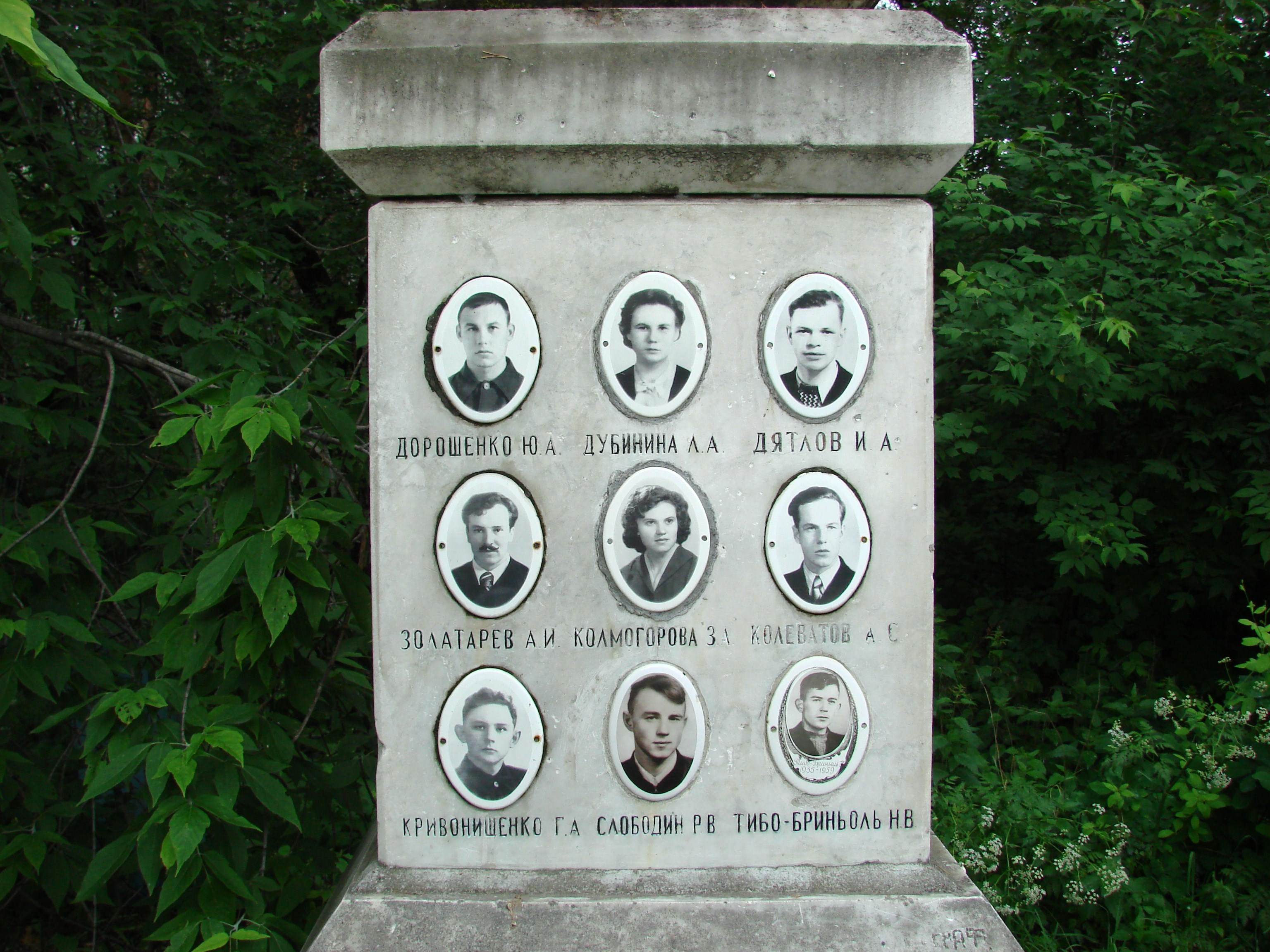
The tomb for the dead. Photo via Wikimedia Commons.

"All of [the deaths] are somehow connected with natural phenomena," Alexander Kurennoi, a spokesperson for Russia's prosecutor, said in a video of the announcement. The Russians say that a group of expert investigators and what have you will be involved in this new investigation. While it's been 60 years since the bodies with the ever so strange positions and injuries were found, Kurennoi said people are still hungry for answers.

"Relatives, the media and the public still ask prosecutors to determine the truth and don't hide their suspicions that something was hidden from them."

In order to understand why the mystery of what's known as the "Dyatlov Pass incident" has been able to survive for 60 years, you needn't look further than the bodies. The entire expedition—minus one hiker who left earlier because of heart problems—died over the same night.

While the route was known as an exceptionally hard one, the group were experienced hikers and camping out on the pass shouldn't have proved fatal to them. Therefore, when they didn't return as expected on February 20, a search party sent out looking for them.

A little under a week after setting off, the party found the tent the group had set—it had been abandoned and was sliced open from the inside. While the camp was deserted, the hikers had left all their belongings and shoes. They seemingly left in a damn hurry through the waist deep snow, leaving behind eight sets of footprints, some of them in socks, some barefoot, others wearing just one shoe. The camp baffled the search party.

It was a few days later when they found the bodies.

The first of the bodies—those of Yuri Doroshenko and Yuri Krivonischenko—were found about a mile from the camp, they were surrounding a small fire under a lone pine tree. Both were stripped to their underwear. It looked like someone had climbed the tree to search for something in the distance. Near this tree, the search party found the bodies of Rustem Slobodin, Zinaida Kolmogorova, and the group's leader Igor Dyatlov—it was noted these three appeared to perish in attempts to make their way back to the camp.

The last four wouldn't be found until the snow melted two months later—eventually turning up 75 metres away from the pine tree in a ravine covered in snow. The four who died here were actually dressed for the weather—i.e. not in their underwear.

Initially, no one thought too, too much of the incident—other than it was an expedition that went bad—as the cause of death for the first five found was to be hypothermia. However, the cause of death for ones that turned up after the snow melted was another story. Three of them were found to have suffered severe injuries. One, Lyudmila Dubinina, was found with no eyes and no tongue. Dubinina and Semyon Zolotaryov were found to have major chest fractures, while Nikolai Thibeaux-Brignolles had extensive skull damage—their injuries were likened to that one would suffer in a major car accident. Oddly though, while there was extensive damage, it was reported that there no external injuries dealt to the bodies—it was like they were crushed by something.

1549480682753-Screen-Shot-2019-02-06-at-20647-PM

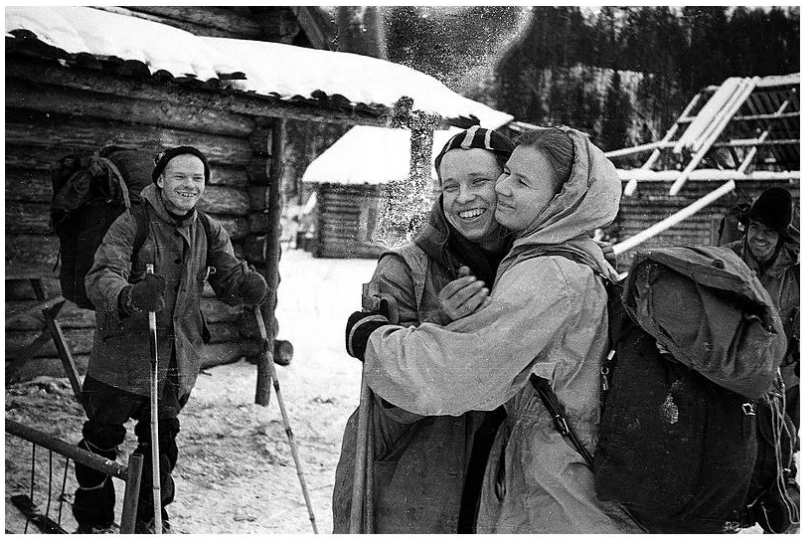
Yudin hugging Dubinina prior to leaving the expedition. Photo via Wikimedia Commons.

On top of the bodies, the amount of weird things have been reported regarding these deaths—some reasonable: trace amounts of radiation on clothes, bodies were a strange tan colour, the eyes and tongue were missing because Dubinina was found in a stream; some not: people seeing orange orbs around the mountain when the hikers were on it, their bodies were prematurely aged, etc—paired with how the Soviets handled it (the deaths were blamed on "spontaneous power of nature" and the case was quickly shuttered) caused many, to this day, to speculate about what actually caused it.

An avalanche? UFOs? Hypothermia driving the crew to madness? A big ol' stumblin' Yeti? Taken out by an Indigenous tribe who considered the mountain sacred? Just type in Dyatlov Pass incident into YouTube or where ever you get your conspiracies these days, and prepare your ass. A shit ton of books, documentaries, teams, and what have you have taken time to look into this theory with no one ever definitely being able to say what actually occurred.

One persistent theory is that it was caused by Soviet weapons testing. These theories range almost as widely as the ones listed above. Some have speculated that they stumbled upon a bombing test ground and were running down the mountain to escape the bombardament. Others claim that the army was testing radiological weapons and that's what caused the weird injuries and the feelings of warmth which led the hikers to stripping.

One explanation, coming from the best-selling book Dead Mountain, is that the wind that whips through Kholat Syakhl in such a way it produces a sound that can cause panic attacks in humans. This caused the hikers to bolt from their tent, and sprint away down the mountain. The injuries to the three bodies were thusly acquired by them falling down the ravine.

Now, hopefully, we'll get our official answer.

The prosecutor's office said they will be flying investigators out to the office to investigate the deaths. Now you would think they would have their hands full—even the Russians acknowledge there are about 75 theories surrounding the deaths—however, they're only going to look into three explanations. The office has officially written off any criminal explanation to the deaths, with Kurennoi saying "there is not a single proof, even an indirect one, to favor this (criminal) version. It was either an avalanche, a snow slab or a hurricane."

I'm not going to lie, at least to me, blaming the deaths on "either an avalanche, a snow slab or a hurricane" isn't too far removed from the "spontaneous power of nature."

Sign up for the VICE Canada Newsletter to get the best of VICE Canada delivered to your inbox.

Follow Mack Lamoureux on Twitter.

The Establishment Goes Trump on China - National Review

President Trump takes part in a welcoming ceremony with Chinese President Xi Jinping in Beijing, November 9, 2017. (Thomas Peter/Reuters)
A new consensus is emerging, and it sounds a lot like what the president has said all along.

Read recent essays on China. Visit think-tank public symposia. Hear out military analysts. Talk with academics and media pundits. Listen to Silicon Valley grandees. Watch Senate speeches and politicians interview on television.

The resulting new groupspeak is surreal. If one excises the word "Trump," what follows is a seemingly revolutionary recalibration of attitudes toward China that more or less echo Trump's voice in the wilderness and often crude and shrill warnings dating back from the campaign trail of 2015.

Trump's second secretary of state, the skillful Mike Pompeo, has been institutionalizing the president's pessimistic view of China. Insightful but heretofore underappreciated assessments from China scholars such as Miles Yu and Gordon Chang are now being taking seriously. Both have been warning us for years that the Chinese seek domination, not accommodation, and are replacing their erstwhile feigned respect for our strength with an emboldened contempt for our perceived growing weakness, whether real or psychological. Both have warned also that once China achieves military, economic, and cultural parity with the United States, the global order will be quite different from that of the last 75 years.

From the military, one hears more frequently now that we were at a tipping point by late 2016: The Obama Asian pivot had failed — publicly provocative, but in reality without substance, giving the lethal impression of real weakness masked by empty rhetoric. The Chinese militarization of the Spratley Islands was conceded as the inevitable future of the South China Sea. Chinese military and weapons doctrine was aimed at destroying the offensive capability of the U.S. fleet in the Pacific as a way of breaking off allies from America, and then Finlanding them.

From 2009 to 2016, our defense readiness was eroding, China's increasing. Psychologically, the American military could not reassure the global order that China would not one day soon unleash North Korea, absorb Taiwan, emasculate South Korea and Japan, or isolate the Philippines and Australia. Huge and mercantile Chinese trade surpluses with all its Western trading partners were accepted as normal.

The cash-short Pentagon seemed to shrug that America was the victim of cosmic and historic forces that inevitably would dethrone the United States, analogous to the declinism of the 1930s, when a powerful U.S. 7th Fleet was not able to deter a modern rising Japanese navy from carving out what would become the Greater Asia Co-Prosperity Sphere based on perceptions of American impotence and weariness and spent European colonialism.

In Silicon Valley, the good old news of making trillions of dollars over the last 30 years in outsourcing assemblage to China, opening up a huge new Chinese consumer market, and entering joint partnerships has insidiously been eclipsed by the growing reality that our techie masters of the universe were instead deluded Dr. Frankensteins who had helped to birth an unstoppable monster.

Technology was stolen, either by espionage inside the U.S. or by formalized theft as the cost of doing business inside China. Copyrights and patents did not bother China. The scale of environmental damage inside China did not diminish, but accelerated and was manifested abroad. There was no sense of symmetry; in dealing with China, the idea of commercial reciprocity, shared environmental protocols, generalized notions of international commerce — all that simply did not exist. And the reason it did not exist wasn't sloppiness or insensitivity; it did not exist by design, owing to the Chinese's arrogance that they were the rising sun and the U.S. was in its twilight — with a few exceptions granted to some of the Western elite who were getting rich largely by accommodating the Chinese warping of trade and technological theft.

Financially challenged colleges and universities had come to rely on full-tuition-paying Chinese students. When stories spread that some Chinese students were acting as organs of the Chinese Communist Party, actively engaging in espionage, or illiberally bullying any critics of China, colleges either ignored such news or regarded its bearers as racists and xenophobes.

Chinese college students who mouthed government talking points were strangely rebranded, in identity-politics fashion, as the victimized Other, and to be accorded the usual accruing exemptions. In sum, China was considered a politically correct entity. Or better yet, it was seen as a cash cow for struggling liberal-arts colleges and so properly immune from any suggestion that it sent thousands of its citizens abroad to absorb or expropriate Western technology without contamination from taboo liberal ideas. While the U.S. obsessed over "Russian collusion" from a thuggish but comparative weak Vladimir Putin, no one worried much about the increasingly boldness of Chinese espionage and cyber sabotage. In Tolkienesque terms of relative threats, Putin played Saruman to a Chinese Sauron.

This willful blindness was similar again to the denseness of Europe and the United States from 1880 to 1920, when Japan had sent tens of thousands of students and liaisons abroad to learn everything from nautical and aviation engineering to assembly-line fabrication and sophisticated steel production. The West, in condescending and racist fashion, was flattered: Such emulation must be proof of Japan's inferiority and desires to become a Westernized (albeit junior) free-market democracy.

In fact, Japanese expropriation was done in a context of arrogance and bitterness over not receiving commensurate recognition after World War I. Japan assumed that whatever was stolen from the West could be improved by superior Japanese discipline, order, and national unity and purpose — far better craftsmanship without the drag of research-and-development costs.

Our diplomats for decades had assured Americans that Chinese trade imbalances, technological theft, gratuitous bullying in the air and sea, disdain for U.S. Asian allies, rampant espionage, and contempt for the postwar commercial order were 50-year-old "growing pains" — the Tiananmen Square road bumps on the inevitable path to liberal society and consensual government.

The arrogant Western idea was that just as free-market economics (rather than jaded mercantilism, dictatorship, and government monopolies) had enriched the Chinese, so too would the accruing bounty "liberalize" Chinese society, ensure an "aware" consumer class, and impress on the country that Western popular culture and politics were just as inevitable and attractive as had been Western profit-making. Or economists and investors insisted that cheap imported Chinese goods meant that the stagnant wages of the middle classes would not matter so much at Walmart — while American business would be forced to be leaner and more efficient to survive the cutthroat competition.

The net result was to ignore or contextualize China's civil-rights abuses, contaminated products, religious persecution, flagrant international aggression, attacks on the postwar global order, neo-colonialism, and abject racism on the grounds these sins were comparable to our own 19th-century bouts with such illiberality — or in some perverse way in the long run even beneficial to the United States.

Again, American finance and corporations invested full bore in Chinese joint projects, offshored, and outsourced — often at the price of giving away key American technological and strategic advantages, hollowing out American red-state industrial and manufacturing capacity, and weakening the nation's cyber and conventional military security.

The idea seemed to be that if a few thousand multimillionaires got even far more fabulously rich by acquiescing to Chinese mercantilism, they could not do real harm to the vast and powerful U.S. Or perhaps, given inevitable American decline, the idea was that they should get their profits in now, before the American golden goose was put out of its misery.

In all these areas and more, a new consensus, among left and right, is now settling in that we are at a crossroads with China. Any more appeasement and acquiescence will lose the West its Asian allies, who will be forced to go with the ascendant superpower, not the declining one.

Either the U.S. military recalibrates or it will return to its 1930s stature of a powerful but vastly overextended Pacific navy and air force. We have reached a cultural nexus at which any more acquiescence would institutionalize the idea that to object to Chinese piracy is to indulge in hurtful stereotypes and therefore should be replaced with appeasement, and that giving away American technology or allowing its expropriation with a wink and nod is not treasonous but simply good business.

The establishment would like to fool itself that it came to its growing about-face on China thanks to a natural exhaustion of patience, or new data, or brilliant new exegeses. And that evolution may be in part true.

But far more likely, Trump's early and relentless hammering on Chinese mercantilism, systematic cheating, and illiberality finally made the old status quo unsustainable in the face of mounting evidence.

The establishment is adopting Trump's once-renegade stance toward China, and yet trying to immunize it from him all the same. So the end result seems something like the following: "That idiot Trump somehow now agrees with us on confronting China."

Victor Davis Hanson — NRO contributor Victor Davis Hanson is a senior fellow at the Hoover Institution and the author, most recently, of The Second World Wars: How the First Global Conflict Was Fought and Won. @vdhanson

Brie Larson on Captain Marvel, Rodarte, and Diversity in Film Criticism - HarpersBAZAAR.com

The Mandarin Oriental Hotel's Asiate Restaurant is a swanky eatery with a killer view of midtown Manhattan. I'd never been to a place like this before and I was intimidated, but I was there to meet with Brie Larson to talk about Captain Marvel, and I needed to get my shit together. When I arrived for our chat on the 36th floor, I greeted her with a hug. "I read the book you gave me!" She said. "It's an intense read."

She's referring to Octavia Butler's Kindred graphic novel, adapted by Damian Duffy and John Jennings. I gave it to her during an event for the film The Glass Castle in 2017. She and I had met in January of that year, when she was looking to use her Instagram to feature women of color expressing their thoughts about inclusion and intersectionality across different industries. I messaged her with a small blurb, not expecting a response, and she promptly published it on her Instagram page.

Larson and I would cross paths again during the Sundance Film Festival in January 2018. Angela Robinson, director of Professor Marston and the Wonder Women, helped facilitate my connection to Time's Up, in which she and Larson are heavily involved. They were interested in knowing more about improving access and opportunity for underrepresented film critics, and I was asked to create a proposal that would help these critics gain elevated access at film festivals. I worked with other entertainment journalists to create the plan, and festivals across the country used it to begin a huge inclusion push, which today can be seen at places like the Toronto International Film Festival, SXSW, and Sundance. While every festival has different requirements, the basis is to provide airfare, lodging, credentials, and sometimes a stipend to critics who qualify.

Brie Larson really helped spearhead this. Because of this, I can be in the same room with the biggest stars in the world, and partake in the biggest interviews of my career. I sat down with Larson to discuss the pressure that comes with taking on a role of this magnitude, her fondness for Rodarte, and ensuring film criticism is an equal playing field.

Harper's BAZAAR: Were you nervous the first day you walked onto set as Carol Danvers? How did you ease into the role?

Brie Larson: I jumped in head-first. The first three days of shooting were all the stuff on the moving train, so it was mostly physical. I had been in pretty heavy training for nine months. [These scenes] bought me some time to get a feel for the suit before we actually got into dialogue.

Brie Larson in Captain Marvel

Disney

HB: I can see how the physicality helped ease the pressure, because you could work off any anxiety pretty quickly.

BL: I think everyone on set was like, "This is insane. I can't believe she's doing a fight sequence on a moving train and it's day two."

HB: My favorite aspect of the movie is the relationship between Carol Danvers and Maria Rambeau. Was it an instant connection between you and co-star Lashana Lynch?

BL: I am an introvert, but I'm super open in scene work. I don't hold back in that, and she doesn't either, so it was a really interesting experience. The two of us did a chemistry read together and it was pretty vibe-y from the beginning. Lashana's a badass and really special, so it was easy to connect with her. We were spending so much time together hanging out that we developed a real bond through it.

HB: What about the connection with Maria's daughter Monica (Akira Akbar)? We get hints of a mentor role for Carol there. Is that something fans will see in the franchise going forward? Maybe a future appearance of Monica as a superhero herself?

BL: Honestly, I have no idea what's in the future for these characters, but I would certainly love to see that. It was so easy to get on with Akira. She's incredible, and so good in the film. Actually, one of my favorite moments with her is when we were filming in Louisiana. In those first couple of days we got rained out a couple times [for scenes] filming outdoors. Lashana, Akira, her younger sister Azari and I ended up jumping in my car while it rained. We were stuck in the car together for an hour goofing off and singing.

From left: Larson, Akira Akbar, and Lashana Lynch in Captain Marvel

Disney

HB: Those are the moments that make filming most enjoyable, those intimate moments folks don't see on screen.

BL: In that moment, I'm sure there were producers somewhere stressed about the rain, but they don't understand what kind of magic ends up onscreen from those moments.

HB: Any other fond memories from set?

BL: I've been thinking a lot about pre-production and working with the stunt team. We worked for a couple hours every day, and the camaraderie we built together helped build trust and a safe space for me. Learning how to punch, kick, and do judo throws when I've never done anything like that before [teaches you] to trust the people you're working with. Learning these new skills totally changed my brain and changed how I played the character, too.

HB: '90s fashion is a big part of the movie. The Nine Inch Nails t-shirt, the flannel—was any of that in your closet growing up?

BL: [Laughs] Well, I was six in the early '90s, but I do remember wearing a lot of Old Navy during that time.

HB: Any favorite accessories come to mind?

BL: I had lots of fuzzy hair clips that had little feathers—and those stretchy choker necklaces. And small or clear backpacks like Jansport.

HB: You wore Rodarte to the Captain Marvel premiere. What is it about designers Kate and Laura Mulleavy and their clothing that keeps you consistently coming back to the brand?

BL: They always materialize my dreams into fashion. They're so feminine and I am proud of that. The dress I wore to the L.A. premiere, it was hand-beaded and just beautiful. Believe it or not, we've been talking about that dress for a year. Laura was at the premiere and held my train on the red carpet. Every stitch of that dress is made with love and to share that moment and environment with them made me feel strong and supported. Their energy is something I will always lean into because they are artisans, geniuses, and my sisters in arms.

Larson in Rodarte at the Captain Marvel premiere

Alberto E. RodriguezGetty Images

HB: In any business, forming a support system or a sisterhood is important, and your help and advocacy has changed a lot for marginalized critics in the entertainment space. Film festivals are making changes by diversifying their critic pool and giving them high-level access, but this is only the beginning. Where do you think we can go from here?

BL: Not to side-step your question, but I feel like that's more for you to answer than for me. You are one of the folks at the forefront of this movement.

HB: I mean, I have been brainstorming solutions...

BL: See, for me, I'm just trying to help other people. It's honestly been so rewarding for me to even have a greater understanding of my industry, and how I can shake the table. This whole ordeal pushed me in new directions and helped me see some of the roadblocks underrepresented critics are having. I felt the Captain Marvel press tour was a step in the right direction.

HB: This is absolutely a great starting point. I understand a lot of education will have to go into this, as so many are uninformed about what we go through, including the gatekeeping. The question I've been grappling with is how do we hold those who shut women and people of color out accountable?

BL: That's the difficult part, right? Figuring out how to do that. I am grateful for progress, but like you said, this is just the beginning.

HB: I try to educate as many people as I can on what's happening in our industry because so many are uninformed or just have no clue about what we go through.

BL: Maybe next step is to create a pipeline of sorts and using this to educate others on what's new, what's available, who's reliable, et cetera.

HB: That doesn't sound like a bad idea, especially with a system in place, or a system that people on both sides of the table can look to for guidance. There definitely needs to be a conversation around that.

BL: Now that the press tour for Captain Marvel is winding down, I'm excited to do a little bit of a roundup to see how the press tour turned out—but now that you've brought it up, I'll also be thinking about what happens next.