Donald Trump, Coast Guard, Jussie Smollett: Your Wednesday Evening Briefing - The New York Times

(Want to get this briefing by email? Here's the sign-up.)

Good evening. Here's the latest.

1. The White House is preparing to establish a panel to study whether climate change is a national security threat, as the government's own scientific and intelligence agencies have warned.

A White House memo describing the panel said it would include William Happer, a climate change denialist, suggesting a new effort by the Trump administration to play down or distort the impact of global warming. Above, heavy rainstorms breached a levee in Novato, Calif., last week.

Mr. Happer, a physicist serving as Mr. Trump's deputy assistant for emerging technologies, is notorious within the science community for his comments that carbon dioxide — the greenhouse gas scientists say is trapping heat and warming the planet — is beneficial to humanity.

2. A Coast Guard lieutenant and self-described white nationalist was plotting to kill a long list of journalists and Democratic politicians when he was arrested last week, the authorities said.

Lt. Christopher Paul Hasson was arrested Friday on charges of illegal gun possession, above, but prosecutors said in a filing on Tuesday that the charges were just the "proverbial tip of the iceberg." They described him as a "domestic terrorist" and said he should be held in detention pending trial because he "intends to murder innocent civilians on a scale rarely seen in this country."

This is a developing story. Check back here for updates.

_____

3. Wall Street is setting its sights on a new target: distressed main streets.

Hedge funds and other wealthy investors are raising money for so-called opportunity funds. Spurred by a provision of the 2017 tax package that provides capital gains relief for spending on projects in poor areas, more than 80 of the funds have sprung up since January 2018.

They aim to invest in about 8,700 designated "opportunity zones," like the one above in downtown Salt Lake City, across the country and in Puerto Rico.

Fund managers are pitching investors on a combination of outsize returns and a feel-good role in fighting poverty, but skeptics worry that the promises are overly optimistic.

4. The Supreme Court found its way to a unanimous ruling: stronger limits on police power to seize private property.

The justices found that the Eighth Amendment's bar on "excessive fines" should include actions in states and localities, in a ruling that stemmed from the case of a small-time drug offender whose $42,000 Land Rover was seized by Indiana officials.

The practice, called civil forfeiture, has been widely used to raise revenue. It has drawn fire from across the political spectrum, and Justice Ruth Bader Ginsburg, writing for eight of the justices, noted its use in Southern states to "subjugate" blacks after the Civil War.

_____

5. "I can't believe it. I ruined my life. I ruined my future."

Four years ago, Hoda Muthana, above, was a 20-year-old college student in Alabama convinced of the righteousness of the Islamic State. But after being married to three Islamic State fighters and witnessing executions like those she had once cheered on social media, she wants to come home.

We spoke with her and a second American woman at a refugee camp in northeastern Syria where they are being held. Less than 24 hours after we published the article, Secretary of State Mike Pompeo said she had no legal basis to return, and President Trump tweeted that he had directed Mr. Pompeo "not to allow Hoda Muthana back into the Country!"

Separately, Vera Mironova, a visiting fellow at Harvard University who has embedded with Iraq's special forces, writes in an Op-Ed essay that women are playing an increasingly important role in the Islamic State — and that security forces are not prepared.

_____

6. The clashes between California and the Trump administration now include a transportation improvement project.

A day after the state joined a lawsuit challenging President Trump's emergency declaration along the border, the Transportation Department said it wanted California to pay back $2.5 billion in federal funds that had already been spent on a bullet train to connect Los Angeles and the Bay Area. The department also said it was terminating a $929 million federal grant for the line. Above, the first leg of the rail line in Fresno, Calif.

Both Gov. Gavin Newsom and Mr. Trump linked the rail decision to the fight over the border wall.

_____

7. Jussie Smollett is now considered a suspect in the case the "Empire" actor reported as a hate crime against him last month.

The Chicago police said that Mr. Smollett was suspected of filing a false police report and that detectives were presenting evidence to a grand jury that he had committed a felony. Mr. Smollett said he had been attacked by two white men in "MAGA" hats who yelled anti-gay slurs, but questions about whether he might have staged the episode have been growing.

Mr. Smollett, through his lawyers, has denied any role in coordinating an attack.

_____

8. Pope Francis and other church leaders will kick off an unprecedented conference on Thursday aimed at addressing clerical sexual abuse. Above, Francis at the Vatican today.

Victims' advocates are calling for a uniform set of laws and zero-tolerance policies around the world, but Vatican officials and other leaders have warned that denial about abuse in some parts of the world and legal and cultural barriers to identifying abusers make a worldwide standard for the church virtually impossible.

We interviewed bishops and priests on four continents and found that, indeed, views vary widely on the urgency, extent and very existence of sexual abuse by priests. In places where Catholics are a minority, reporting a priest to the authorities could be a death sentence.

10. Finally, a horse of a different color.

Researchers in Britain dressed up horses in zebra coats to confirm a theory about the evolution of zebra stripes. The stripes seem to make it difficult for flies to land on their bodies, which might explain why they evolved in the first place, researchers found.

The high contrast between black and white most likely tricks the fly's low-resolution vision, which relies on sensing movement. "It's probably just blowing the fly's vision away," one researcher said.

It's also probably time to invest in some zebra print.

Have a wild night.

_____

Your Evening Briefing is posted at 6 p.m. Eastern.

And don't miss Your Morning Briefing. Sign up here to get it by email in the Australian, Asian, European or American morning.

Want to catch up on past briefings? You can browse them here.

What did you like? What do you want to see here? Let us know at briefing@nytimes.com.

Donald Trump, Theodore McCarrick, Colin Kaepernick: Your Weekend Briefing - The New York Times

Here are the week's top stories, and a look ahead.

1. President Trump declared a national emergency on the border with Mexico on Friday in an effort to access billions of dollars that Congress refused to give him to build a wall there.

The president asserted that the "invasion of drugs and criminals" coming across the border constituted a threat to national security and justified unilateral action. But illegal crossings are already down and critics are accusing him of manufacturing a crisis. Above, migrants waiting along the border fence in Penitas, Tex., on Feb. 1.

Mr. Trump acknowledged that his declaration would be litigated in the courts and even predicted a rough road for his side. Senate Republicans are now faced with the hard choice of defending their institution, which Mr. Trump is attempting to circumvent, or bowing to the president's whims.

The border is sometimes treated like a political football, but it's also home to millions of people. Every week for the next few months, our Crossing the Border newsletter will bring you their stories.

2. Pope Francis defrocked Theodore E. McCarrick, above, a former cardinal and archbishop of Washington, after a canonical process that found him guilty of sexually abusing minors and adult seminarians over decades.

It appears to be the first time that a cardinal or bishop in the United States has been expelled from the priesthood of the Roman Catholic Church, and the first time any cardinal has been defrocked, or laicized, for sexual abuse.

Few of the church's leaders have faced such severe discipline. The move to defrock Mr. McCarrick is "almost revolutionary," a professor of canon law said.

____

The court stepped in before any appeals court had ruled on the matter, putting the case on an unusually fast track — almost certainly because census forms are set to be printed in June.

Justice Ruth Bader Ginsburg was at work that day to participate in adding cases to the court's docket, her first appearance since having cancer surgery in December. She is expected to be on the bench on Tuesday when the court returns from its midwinter break.

____

4. William P. Barr is now head of the Justice Department, for the second time, after the Senate confirmed him as attorney general on Thursday.

Mr. Barr, above, assured senators that he would not allow political interference to sway the department's work, but offered no specific assurances that he would make the findings of the special counsel's office on Russian election interference public.

On Wednesday, a federal judge ruled that Paul Manafort, Mr. Trump's former campaign chairman, had deliberately lied to prosecutors after pledging to cooperate with the special counsel, thereby breaching his plea agreement. The special counsel's office recommended Friday that Mr. Manafort serve up to 25 years in prison and pay up to $25 million in fines in his financial fraud case.

____

5. Sexism on the campaign trail can affect not only how voters perceive candidates but how candidates present themselves to voters.

And now the influence of stereotypes and double standards is about to play out in uncharted territory: At last count, six women were running for the Democratic nomination, including Senator Kamala Harris of California, above.

Ms. Harris, a former district attorney and state attorney general, is running as a "progressive prosecutor" — and facing a chorus of skepticism, especially from the left. Another candidate, Senator Kirsten Gillibrand of New York, is making running as a woman, for women, the central theme of her candidacy.

____

6. Marjory Stoneman Douglas High School in Parkland, Fla., had a "day of service and love" on Thursday to commemorate the 17 lives lost a year ago in one of the nation's deadliest school shootings. Above, community members at a memorial garden.

We spoke to several students, as well as parents, police officers and a teacher, about how their lives were transformed by the massacre.

"My life is not normal," said Anthony Borges, 16, who took five bullets as he barricaded a classroom door to protect other students. "It will never be like before."

____

7. Amazon on Thursday backed out of its plans to build an expansive corporate campus in New York City after unexpectedly fierce backlash from lawmakers, progressive activists and union leaders.

The company had promised to create more than 25,000 jobs in return for nearly $3 billion in government incentives. The deal stirred debate in New York about the use of public subsidies, the rising cost of living and the city's very identity.

Amazon grew increasingly concerned that the backlash showed no signs of abating and was tarnishing its image beyond the city. We pieced together how the ambitious deal collapsed.

8. The Mexican crime lord known as El Chapo was convicted on Tuesday following a three-month drug trial that exposed the inner workings of his sprawling cartel.

The kingpin, above, whose real name is Joaquín Guzmán Loera, was found guilty on all 10 counts of the indictment and faces life in prison. Here are the 11 biggest takeaways from the case.

While the conviction was a huge victory for American law enforcement, it may have little lasting impact on either Mr. Guzmán's cartel or the wider effort to stem the flow of drugs into the United States, writes Alan Feuer, the Times reporter who covered the trial.

____

9. Colin Kaepernick and a former teammate, Eric Reid, reached a surprise legal settlement with the N.F.L., which they had accused of colluding to keep them out of the league for kneeling during the national anthem at games to protest police shootings of black people. Above, from left, Mr. Reid and Mr. Kaepernick at a game on Sept. 12, 2016.

Mr. Kaepernick and other players who participated in the protest drew the ire of President Trump and some N.F.L. fans who boycotted games. Other fans also boycotted the N.F.L. with the belief that Mr. Kaepernick was blacklisted for leading the movement.

Here's a timeline of Mr. Kaepernick's protest.

____

10. Finally, don't miss our Best Weekend Reads.

We talk to women who accused the singer-songwriter Ryan Adams of emotional and verbal abuse; look at the secret history of women in coding; and say goodbye to the NASA Mars rover Opportunity.

For more suggestions on what to read, watch and listen to, may we suggest these nine new books our editors liked, a glance at the latest small-screen recommendations from Watching, and our music critics' latest playlist.

Have a great week.

Your Weekend Briefing is published Sundays at 6 a.m. Eastern.

You can sign up here to get our Morning Briefings by email in the Australian, Asian, European or American morning, or here to receive an Evening Briefing on U.S. weeknights.

Browse our full range of Times newsletters here.

What did you like? What do you want to see here? Let us know at briefing@nytimes.com.

Why Does Netflix's Tidying Up with Marie Kondo Provoke Such Strong Reactions? :: TV :: Features :: Tidying Up with Marie Kondo :: Paste - Paste Magazine

It began with the books.

In the fifth episode of her new Netflix series, Tidying Up, organizing consultant Marie Kondo guides a young couple through the process of de-cluttering their stacked tomes: Collect all of the books in your home into a mountainous pile, hold each one in your hands, and ask, "Does this spark joy?" Soon enough, the "KonMari method" came in for criticism, some rooted in misinterpretation—the notion that requiring books to "spark joy" militates against challenging literature—some in misinformation—an erroneous meme in which Kondo suggests keeping no more than 30 books—and some in cheek. "Suddenly people have noticed the dark side of Kondo's war on stuff," Washington Post book critic Ron Charles wrote, in a flailing attempt at humor: "She hates books."

Though Charles admits that Kondo's advice is not quite so "outrageous," he prefers to regale us with the organizational systems he's developed as an academic-turned-critic-turned-Pulitzer Prize judge. (Call it RonChari.) As such, he manages to quote three of Kondo's broad aphorisms—two from the TV series and one from her bestselling book, The Life-Changing Magic of Tidying Up—but misses out on the reality program's main appeal, which is seeing her method in action. After all, the lesson she teaches the young couple reflects an avid reader's feelings about books: To explain what she means by "spark joy," she asks one of the men to touch a book he couldn't imagine parting with, and he leafs through a dog-eared copy of To Kill a Mockingbird, fondly remembering the experience of reading it for the first time.

Had it ended with the books, with garbled messages and short-lived controversies, one might've described the reaction to Tidying Up as following the pattern of most cultural criticism: argument, counterargument, rebuttal. Rather than petering out, though, the discussion of Kondo, her method, and her Netflix series, which premiered on New Year's Day, has now smoldered on for more than a month, covering the limits of minimalism, elitism and "social signaling," and, on Monday, author Barbara Ehrenreich's ill-conceived "joke" about the series' use of subtitled Japanese and the decline of American power. For comparison's sake, my rule of thumb as Paste's TV editor is to cover streaming series within the first two weeks after their release. Tidying Up with Marie Kondo has touched a nerve.

As Muqing Zhang writes at Paper, Kondo's race is a factor here, such that the response to Tidying Up reflects the treatment of Asian women as "either a fetishized exotic experience or embodiment of a yellow peril threat." But to say that "the white public has suddenly turned against her" de-contextualizes the complex of anxieties Kondo provokes, reducing the reaction to a kind of viral backlash. Race, nation, and language are key to understanding why Tidying Up—bringing change to its subjects' homes that seems insignificant alongside the metamorphoses of Netflix's Queer Eye, to say nothing of Trading Spaces, Extreme Makeover: Home Edition, and HGTV's slate of real-estate porn—has become the most unlikely of cultural flashpoints, but it's the specific, intertwined histories of Japanophilia and Japanophobia in the United States that might help us understand why now.

In the form Zhang identifies, the incoherence of American attitudes about Japan and its people dates back to the second half of the 19th century, when elite appreciation for Japanese art, fashion, and culture—not to mention immigrant labor—began to erode in the face of xenophobia, stoked by race scientists, poets, journalists, and politicians, and often supported by the white working-class. (As it happens, my undergraduate honors thesis at the University of Southern California was on the origins of anti-Chinese and anti-Japanese nativism in California. The remainder of this paragraph is drawn from that research.) To this end, the San Francisco Chronicle identified the Japanese as a "Danger at the Door" in 1893, the year before the Japanese Pavilion, which became a popular teahouse, was built in Golden Gate Park; the founding president of Stanford University, David Starr Jordan, recruited Japanese students and formed the Japan Society of Northern California in 1905, only for the Roosevelt administration to enter into an informal "Gentleman's Agreement" with the Japanese government to limit immigration two years later. Many of these contradictions fell within the realm of the intimate or domestic, too: As architects imitated Japanese techniques, socialites donned floral kimonos, and the Los Angeles Times cited Japanese "good-boys" as a solution to the "exceedingly difficult problem of domestic help," for instance, the Chronicle warned that "the intimacy encouraged between Japanese servants… has resulted very disastrously, from the standpoint of morality."

This American attraction to/repulsion from Japan has played out again and again, often in unexpected cultural arenas. Admiration for the sacrifice and self-denial described in Nitobe Inazô's Bushido became concern over its antiquarian militarism after the Japanese invasion of Manchuria in 1931, for instance, while heightened interest in Japanese corporate management in the early 1980s morphed, within the course of a decade, into Japanese domination (or worse) as a pop cultural trope, from Die Hard to Michael Crichton's Rising Sun. In short, our dual (and dueling) fascination with and fear of Japan, its culture, and its people tends to appear, in sometimes surprising fashion, at moments of acute socioeconomic distress—the Gilded Age, the Great Depression, the Reagan era, and now, perhaps, the present.

As historians say, the cycle of fetishization and vilification Zhang describes is "contingent," born of particular factors coming together at particular places and times, and in this framework, the scale, duration, and intensity of the reaction to Kondo is no longer so surprising. Just as the samurai of Inazô's reckoning might be seen as "traditional" or "antiquarian," and the Toyota of the 1980s as "efficient" or "robotic," the "clutter" and "mess" in Tidying Up become the blank canvas onto which the series' subjects and viewers alike project their concerns about space, time, money, gender roles, and much more besides. The first episode alone, featuring Rachel and Kevin Friend and their two young children, doubles as a précis of profound dislocations in modern American life: the division of household labor, including childrearing—Rachel does most of it—the length of the workweek—Kevin's is 60 hours or more—the emptiness of rapacious consumerism, and the collective havoc these wreak in the couple's marriage. In the course of eight episodes, "tidying up" emerges a metaphor for empty nesters facing retirement, millennials striking out on their own, a couple trying to balance career dreams and financial reality, and a widow finding new purpose, and the eagerness to celebrate or condemn the series—an otherwise milquetoast entry in the home improvement genre—suggests that it's the situations in Tidying Up we're responding to, as much as Kondo's solutions.

Understanding why it is that Japan holds this place in the American imagination—and not China, Korea, the Philippines, or Vietnam, despite being subject to many of the same stereotypes—involves more specific, intertwined histories than I can reasonably outline here, though I suspect the United States' distinct relationship with Japan, neither colonial trading post nor Cold War proxy, is at the core. Knowing that it does, though, begins to explain the defining feature of the Kondo phenomenon, which is that the sense of grievance or affirmation American audiences seem to find in Tidying Up is far more engrossing than the series itself. In fact, by ushering the series' subjects through the KonMari method, in which one's belongings are amassed in a giant mound, Kondo replicates Japan's long-standing role as a projection of American anxieties: As she says through her translator when Rachel Friend expresses embarrassment at the heap of clothes on her bed, the process is designed to "confront" us, in this case with a material reflection of our selves.

My point isn't that critics of the series necessarily harbor anti-Japanese sentiments, or that its fans are necessarily fetishists, though the language used by Ehrenreich and others underscores that such attitudes remain all too common. Rather, whether you bristle at minimalism or decide to embrace it, find yourself inspired to clean house or revel in clutter, your reaction speaks to hopes and fears that are political as well as personal, contingent as well as universal, historical as well as eternal, an insight that Tidying Up renders so explicit you cannot help but confront that, too. The books I accumulated in high school and college remain boxed up, untouched, in my parents' garage after nearly a decade; I own artwork I've been meaning to get framed for five years; I managed to procure a hand-me-down mattress from a friend last summer but never added a box spring or bed to match—yes, this is the decision-making, or more precisely the paralysis, of a man afraid to commit, a footloose bachelor in his early 30s, but it is also the plight of a generation for whom job security and home ownership, much less creature comforts, are thwarted desires, not promises kept.

It's at the moments in which the wires cross, when contentment with the American system bleeds into anxiety about it, that we tend to look elsewhere for a model of how to live, and in turn find ourselves enchanted by, or resentful of, what we're told about how things are, or should be. In fact, the season's most telling sequence suggests much the same confusion, as Rachel, arguing with Kevin over what to do with 200 clothes hangers, poses two questions in quick succession. "Do they keep you up at night?" she asks. "Do they bring you joy?" It's Tidying Up in a nutshell, the perfect contradiction, and no matter the reaction you have to your belongings—or the series itself—the answer should precipitate a follow-up question: Why?

Tidying Up with Marie Kondo is now streaming on Netflix.


Matt Brennan is the TV editor of Paste Magazine. He tweets about what he's watching @thefilmgoer.

New Razer Blade Stealth vs. Apple's MacBooks - MacRumors

For the last few years, Razer, known for its gaming PCs and accessories, has been making the Razer Blade Stealth, an ultrabook that's quite sleek and snazzy.

We went hands-on with the latest version of the Razer Blade Stealth, released in 2019, to see how it compares with Apple's MacBook options.

Subscribe to the MacRumors YouTube channel for more videos.

The Razer Blade Stealth, for those unfamiliar with it, is a 13-inch ultrabook offering solid performance in a slim, compact package. It has an aesthetic reminiscent of the MacBook Pro, which is also super slim, but it looks quite a bit different with a black aluminum unibody and squared edges.

Most notably, the Razer Blade Stealth has an option for a 4K display, which is the version we have on hand. You might think a 4K display would look way better than the the lower-resolution displays on Apple's Retina MacBook Air and MacBook Pro, but on such a small machine, it's not as noticeable as you'd expect.


The display is touch sensitive, which is not a feature on Apple's laptops, and it has super narrow side bezels so it has a clean, modern look. The keyboard has more travel than the butterfly keys of the MacBook line, but not as much clickiness, and there's a full set of physical function keys instead of a Touch Bar.

This is Razer we're talking about, so naturally there's customizable RBG backlighting for the keyboard that can be set to different colors and themes. There's a much smaller trackpad, but it's still nice to use and one of the better non-Apple trackpads we've tried. There's no fingerprint sensor like on the MacBook Pro and MacBook Air, but there is a Windows Hello facial recognition option.


When it comes to ports, the Razer Blade Stealth has two USB-C ports and two USB-A ports, along with a 3.5mm headphone jack. Just one USB-C port is Thunderbolt 3 capable, compared to four on all of Apple's USB-C MacBook Pro models.

The Razer Blade Stealth is equipped with 16GB RAM, a quad-core 1.8GHz 8th-generation Intel Core i7 processor, and a dedicated Nvidia GeForce MX150 graphics card. Apple's 13-inch MacBook Pros, the closest in form factor to the Razer Blade Stealth, have an integrated GPU.

Benchmarks indicate the Razer Blade Stealth outperforms the 13-inch MacBook Pro, especially when it comes to the GPU. That's not unexpected, though, because Razer is a gaming company. Razer also sells the Razer Blade Stealth alongside the Razer Core X external GPU to offer desktop-quality gaming.


In our testing, the Razer Blade Stealth did well with everything we threw at it, including browsing the web, watching videos, editing video with Adobe Premiere Pro, and some light gaming. Unigine Heaven benchmarks required us to drop the resolution to 1080p from 4K to get 60 to 70 frames per second, though, and it struggled at the full 4K resolution for gaming.

On an OpenCL test, the Razer Blade Steath scored 47,237 with the GeForce MX150 and 36,488 for the integrated Intel Graphics 620. For comparison's sake, the built-in GPU in the 2018 15-inch MacBook Pro scored 23,624, and the AMD Radeon Pro 555X scored 50,257. That's a little bit like comparing apples to oranges, though, as the 15-inch MacBook Pro is a bigger machine and the 13-inch model, which is a closer comparison to the Razer, has no dedicated graphics.

Battery life in the Razer Blade Stealth is okay. It's lasted for about six hours for tasks like web browsing and emails, but for more system intensive tasks, it can drain in less than three hours because of the power draw of the 4K display.


When it comes to price, Razer is charging a premium for its ultrabook, much like Apple does with its notebooks. The 4K 13-inch model we have on hand with the MX150 graphics card is priced at $1,900, though Razer offers lower tiers priced at $1,600 (no 4K) and $1,300 (no 4K and integrated graphics).

Given these price points, the Razer Blade Stealth is tough to recommend over other PC options, but it's powerful, portable, and gorgeous. What do you think of the Razer Blade Stealth? Let us know in the comments.

The Razor Blade Steath looks pretty good. Great features. Now if only it didn't run the abomination called Windows 10.
This crushes the MBP in price to value
Razer Blade got a vapor chamber cooling system which is way better than MacBook Pro.
Does the Stealth run macOS? Nope

I didn't buy a MacBook for the hardware.

Given these price points, the Razer Blade Stealth is tough to recommend

You must be joking, surely? It has a 4K display and a dedicated GPU. It's far better value than most of the MacBook Pro's/MacBooks and you never mention the price being a reason not to buy those.
Does it have a keyboard that doesn't get crippled with a few specks of dust? If it does, it's already better than a MBP
Has anyone noticed how buggy Windows 10 is with high resolution displays? Some apps on my Windows (work) laptop have tiny or huge UI elements, and Windows 10 feels so unpolished to me. That's enough to keep me away form this laptop. I wish I could use a MacBook at work.

When it comes to price, Razer is charging a premium for its ultrabook, much like Apple does with its notebooks. The 4K 13-inch model we have on hand with the MX150 graphics card is priced at $1,900, though Razer offers lower tiers priced at $1,600 (no 4K) and $1,300 (no 4K and integrated graphics).

Given these price points, the Razer Blade Stealth is tough to recommend over other PC options, but it's powerful, portable, and gorgeous.


This is rather odd phrasing.

At the starting point of $1,399, Apple has a better deal in some ways: the $1,299 13-inch MacBook Pro has a much better integrated GPU (Iris Plus 640 vs. UHD Graphics 620), but last generation's CPU (both of which is Intel's fault: you can't get the better graphics on the newer CPU at the same wattage), with half the cores. It also only has half the SSD storage, though. You can double that and come out at $1,499.

But then the deals get worse. Configure the Razer with GeForce graphics and twice the RAM, and you're at $1,599. There's no dedicated graphics option at all from Apple, and yet, at 16 GB RAM, you're already looking at $1,699. Or you can go $1,899 for both contenders, and end up with a 512 GB SSD in both cases, but the Razer, again, has dedicated graphics.

Want a more comparable CPU? Then you're looking at $1,799 on Apple's end. You gain the Touch Bar and Touch ID. This configuration again has a better integrated GPU than Razer's lowest, but the same amount of RAM and SSD storage, at $400 more. Add the Razer's dedicated GPU, and you basically don't get a comparable offering from Apple.

In summary, no, Razer isn't cheap either, but Apple is in most of these configurations more expensive, typically by hundreds of dollars, and no matter what, you can't get a 13-inch dGPU MacBook Pro.

Has anyone noticed how buggy Windows 10 is with high resolution displays? Some apps on my Windows (work) laptop have tiny or huge UI elements, and Windows 10 feels so unpolished to me. That's enough to keep me away form this laptop. I wish I could use a MacBook at work.


Short answer: yeah, unfortunately, DPI scaling is still a mess on Windows.

Long answer:

Since Windows 95 (98?), there has been a slider to set text scaling, and these days, it tends to offer fractional options like 100%, 125%, 200%, 250%. Starting with Windows 8.1, this scale can also differ between displays, so you can have an external display with a different scaling (which these days tends to be a common set up — your laptop is at 200% or more, but your external display is not). And yet… in practice, it doesn't work well. They keep making improvements, keep giving third-party developers more tools, keep iterating, but… it's still a bit of a mess.

Apple started out a similar path during the era of 10.4 Tiger, and let developers play with that ('https://arstechnica.com/gadgets/2005/04/macosx-10-4/20/#scalable-ui'). But even in 10.5 Leopard, this feature didn't look ready for prime time ('https://arstechnica.com/gadgets/2007/10/mac-os-x-10-5/9/'). There were numerous visual glitches that boiled down to: scaling a UI to arbitrary sizes sounds like a simple math problem, but really isn't. And it sounds like a cool feature, but is it that useful?

This bold approach of allowing arbitrary fractional scale factors was eventually abandoned in favor of only allowing integer factors. Your UI is 1x, 2x (such as on Retina Macs), 3x (such as on the iPhone 6 Plus). That's it. This is much, much simpler to accomplish, as all you have to do when scaling bitmap graphics is turn one pixel into a 2x2 grid or 3x3 grid of pixels.

Microsoft keeps trying to do the hard thing. Meanwhile, Apple has accomplished the easier thing. To the user, Apple's approach looks great, and Microsoft's just… doesn't. It's a bolder, more comprehensive approach, but it solves a problem that arguably isn't all that useful to solve, at the cost of a mediocre real-world experience.

It has an aesthetic reminiscent of the MacBook Pro, which is also super slim, but it looks quite a bit different with a black aluminum unibody and squared edges.

It's like they mixed Apple's old black MacBooks with their current MacBook Pros.

US's trade war with China is America First vs. Asia First - Quartz

America can't become great again without Asia.

President Xi Jinping's announcement that China will accelerate its market opening to more American high-tech goods and make greater efforts to protect foreign intellectual property is welcome news for American firms, the stock market, and global trade as a whole. But we shouldn't confuse blips and trends.

The long-term trajectory is clear: Asia is not just rising—it is also decoupling from the US.

The past two decades have witnessed Asia come out of its 1997-1998 financial crisis and rebuilding its economic fundamentals sufficiently to withstand the 2007 Western financial crisis. Here are just a few metrics that indicate growing Asian confidence (and even self-sufficiency) from capital to capacity-building:

  • Asian countries generally have lower debt, higher reserves, and manage currencies through trade-weighted baskets rather than US dollar pegs.
  • All of the largest holdings of currency reserves are in Asia.
  • Japan and China have become the largest international creditors.
  • Meanwhile, Asian central banks have boosted the liquidity of currency-swap agreements, and their governments have launched a new set of diplomatic frameworks such as the Regional Comprehensive Economic Partnership, the Belt and Road Initiative, and the Asian Infrastructure Investment Bank.
  • Local currency borrowing has displaced large, outstanding US-dollar-debt obligations, giving governments much more long-term investment capacity with less concern for currency volatility. Not only have Asia's developing economies thus weathered multiple "taper tantrums" as US interest rates rise, but their own rates are now more correlated to each other and have remained low.

The Asian sphere of intensifying political and economic convergence stretches far beyond China, from the Gulf countries to Japan and Russia to Australia. This geographic Asia is also the strategic Asia, with five billion people—more than the rest of the world combined—looking more toward each other than to Europe or North America.

Asia is not just rising—it is also decoupling from the US.

There is currently $4.5 trillion annually traded in the Northeast Asian triangular among China, Japan, and South Korea, and trade within Asia represents more than 60% of total Asian trade. Asia today is thus becoming what Europe and North America already are: a regional system in which members have more to do with each other than with states from other regions.

The great story of the 21st century is therefore not merely the rise of Asia, but the Asianization of Asia. The Obama administration attempted a "pivot" to Asia, its centerpiece being the Trans-Pacific Partnership (TPP) trade agreement, which would have pried open Asian markets further to American goods. But with the Trump administration pulling the US out of the TPP, alienating its closest Asian allies such as Japan and South Korea with his tariffs on steel and other vital goods, it's not clear what America's role in Asia will be in the decades ahead.

The return of Afroeurasia

Asia in the 21st century most resembles Asia of the 15th century, the pre-colonial era in which East Asian empires, Indian dynasties, Arab caliphates, Indonesian maritime traders, and Mongolian steppe nomads all co-existed in dynamic patterns of commerce, conflict, and cultural exchange.

Before Ferdinand Magellan and the encroachment of Portuguese, Spanish, and Dutch merchant navies, Asians ruled the Indian Ocean waves. Scholars of the more than thousand years of pre-colonial history of this region refer to it as an "Afroeurasian realm" of Silk Roads spanning land and sea, with ethnic intermingling and trade networks spanning East Africa to Korea. The Trump administration's growing usage of the term "Indo-Pacific" merely reflects the reemergence of this ancient reality.

The more Trump digs in behind his "America First" campaign, the more Asians are wisely hedging against excessive dependence on the US market. They are doing this by increasing trade with each other, which is precisely what China, Japan, and South Korea agreed to last autumn. Unlike the US, Japan and South Korea have relatively balanced trade with China; South Korea even has a significant surplus. And while they are equally concerned with China's rapid moves up the value chain, their strategy is to boost innovation and aggressively sell more into China. (It is worth noting that Canada and Mexico have enthusiastically joined TPP by the same logic, despite their sizeable deficits with Asian trade partners.)

The tariff escalation between the US and China has convinced Asians that they cannot rely on the US as a risk-free supplier of critical goods. The lesson Chinese firms have taken away from Trump's export controls on American firms is that they should permanently substitute American high-tech imports with those from these nearer Asian trading partners, with whom they already trade more and have more leverage.

From semiconductors to soybeans, permanent substitution has become Asia's top priority. Indeed, in the intervening years since Chinese handset and telecom equipment manufacturers signed long-term deals with Qualcomm, Intel, and other American firms, China has decreased its dependency on US suppliers. It now imports nearly 70% of its high-tech goods from Japan, South Korea, Taiwan, Singapore, and Europeans. The logic of globalization dictates that the more Trump tries to isolate China, the more everyone else—from Canada to Latin America, and Europe to Japan—will do their best to capture America's market share in China and Asia more broadly.

From America First to America Alone

America First is not working for America. Retailers are raising the cost of goods to consumers, and America's allies are gaining market share abroad at its expense. America's manufacturing and agricultural sectors are going to feel the pain most acutely, for reasons that pre-date the trade war but will accelerate the longer it persists.

China's soybean importers now favor Brazil and Argentina, leaving Trump to spend taxpayer money bailing out American farmers. The only consolation is that Argentina has had to buy American soybeans and ship them onward to China in order to meet China's massive demand.

America's factory workers won't be so lucky. Since most American-manufactured goods—from steel and appliances to electronic equipment and aircraft—can be much more readily substituted by competitors, once foreigners stop buying American, they're not likely to start again.

Take the example of General Motors. At first, Asia was a bright spot for the US car manufacturer. Earlier this year, GM recorded its highest level of car sales in China, where car ownership is still expanding (though not as rapidly as in recent years). But with the recent headline that GM will be slashing thousands of jobs and closing several US plants, GM will lack the capital to expand in Asia to cope with demand—and to keep pace with competition as companies from Ford to Chevy (as well as European carmakers) race ahead to capture the region's swelling electric car market.

American firms can only afford to employ more Americans if they have strong global profits, something that can't happen if American revenues in Asia decline. GE's plant closures and declining investment are no doubt a blow to Trump's "Buy American" agenda, but he has only himself to blame. Tariffs on China have raised steel prices across the manufacturing sector, while domestic demand is flat. Then there are the expanded "rules of origin" requirements in the new USMCA agreement (or "NAFTA Plus"), which were intended to benefit the auto sector. But as the Peterson Institute points out, these quotas will actually benefit cheaper steel and auto-part manufacturers, particularly from Asia, while reducing investment in the US and its neighbors.

There couldn't be a worse time to make access to Asian markets harder for American firms. Asia is experiencing a surge in corporate patriotism, from Chinese smashing Apple iPhones in public and switching to Huawei to Grab taking over Uber's operations across Southeast Asia and the Luckin coffee chain challenging Starbucks.

To succeed globally, one has to manufacture and sell globally. This is especially true given America's aging demographics, weak infrastructure investment, and saturated markets. Most Fortune 500 American companies such as Apple generate as much as half or even more of their global revenue from abroad; the American market just isn't big enough. As Apple loses market share in Asia to local competitors, its market cap is feeling the pinch. American manufacturing will continue to decline unless it embraces Asia by going back to the TPP trade agreement—and hope that China eventually joins it as well.

Asia's decoupling is great news for Asia, but much less so for the US. America's share of global trade will slide further below other regions. On the one hand, this reflects the fact that America does not need the rest of the world for its survival. In geopolitics, that is a blessed condition. But in geoeconomics, it means the US is actually much more dispensable than it thinks. Indeed, China's most significant trade relationships are first and foremost other Asians, followed by Europe, with the US third most important. From China's standpoint, number three just launched a trade war against number one.

It has taken one short generation for Asia to launch its decoupling from the US—and the coming generation will witness even more couplings among Asians themselves. "America first" sounds like a great idea, except when it actually means "America alone."

This essay is adapted from The Future is Asian: Commerce, Conflict, and Culture in the 21st Century (Simon & Schuster, 2019), which came out this week.

This article is part of Quartz Ideas, our home for bold arguments and big thinkers.

Italy’s Deal With China Signals a Shift as U.S. Influence Recedes - The New York Times

ROME — For decades, Italy felt the brunt of the Chinese economic juggernaut that the United States argues poses a threat to the financial and political future of the West.

China's government-backed manufacturers, operating on a much larger scale with much cheaper costs, devoured small Italian companies producing machinery, textiles and pharmaceuticals. Chinese knockoffs infuriated its high-fashion brands.

But this month, as the United States continued to engage in a trade standoff with China, and leaders of the European Union banded together to demand an end to unfair Chinese business practices, Italy took another route — China's new Silk Road.

In a move that signaled geopolitical shifts from West to East, Italy broke with its European and American allies during last week's visit by President Xi Jinping of China, and became the first member of the Group of 7 major economies to officially sign up to China's vast new One Belt One Road global infrastructure project.

"This is not being isolated from Europe, this is Italy leading," Michele Geraci, Italy's under secretary for economic development, and the driving force behind the deal, said in a telephone interview from China's southern Hainan province.

"And when you lead," he added, "you do need to be alone for a split second. But this bit is going to be very short."

Italy's transactional tradition in trade and foreign policy, its anti-establishment government's antagonism toward the European Union, the failure of the United States to intervene effectively and China's expertise in exploiting political dysfunction — all of those things contributed to the making of the deal.

So, too, did Italy's desperation for investment, access to China's enormous markets and anything resembling an economic uptick.

But Italy's keen sense of history and awareness to the shifts of great powers also may have had something to do with it.

While the United States has been a close ally since World War II and is home to an enormous Italian diaspora, Italy is no stranger to China.

Ancient Romans prized Chinese silk and the Chinese valued Roman glass. Marco Polo captivated the West with his turn-of-the-14th-century tales of trading with the wealthy East, and the Italian Jesuit Matteo Ricci produced a map of the world in Chinese characters that revealed European exploration to East Asia.

Now as the United States has withdrawn from the world, China is front and center on Italy's map again.

This week, Prime Minister Giuseppe Conte of Italy said that as China exerts a stronger influence on the world's economy, it is going to exert "an increasing influence also at the political level."

Mr. Conte was speaking at an event in Rome held by a Jesuit magazine to discuss the Vatican's own breakthrough deal last year with China, in which Pope Francis made concessions to the Chinese government in order to bring all the Chinese bishops into communion with Rome, and to gain more access to the world's most populous country.

In front of an audience of top diplomats, prelates and government officials, all eager to learn more about China, Mr. Conte spoke admiringly of China's efforts to become a world leader in "technology and in innovation, leadership that we know is very contested by the United States."

The United States, in fact, sought to stop Italy's joining of the Silk Road.

This week Secretary of State Mike Pompeo said he was "saddened" by the development. On Thursday, Luigi Di Maio, Italy's deputy prime minister and the political leader of the Five Star Movement, met with National Security Adviser John R. Bolton at the White House.

Mr. Di Maio told reporters that he assured the Americans that the China deal was purely about commerce and that Italy remained firmly in the political orbit of the United States, which has vastly more money invested in the country than China does.

In the months before the deal, Mr. Di Maio repeatedly visited China, and nearly made a deal in November, Italian officials said. All along, the Italians said, they heard barely a peep from top officials in the United States, and by the time Mr. Bolton's spokesman went public against the deal earlier this month, it was too late.

A senior government official, speaking on background to discuss internal deliberations, said Washington would have engaged sooner if it had understood that Italy planned to officially join the new Silk Road, which it sees as a strategic threat.

The official said the chaotic nature of Italian politics and the fact that visits to Beijing had become the norm for European leaders made it harder to discern what the Italians were up to.

Indeed, already 16 central and eastern European countries, including 11 members of the European Union, have formal business relations with China.

The Chinese have essentially bought the port of Piraeus, outside Athens. The new deal will now also allow it access to critical Italian ports, like Genoa and another in Trieste, which has a rail link reaching right into the heart of Central Europe.

This month, Mayor Roberto Dipiazza of Trieste looked out his window at a cruise ship that was to set sail for China, following the route of Marco Polo. He said that despite the American criticism, "if the Chinese come it is a great opportunity for development, for work, not only for my city, but for my country, for an important part of Europe."

Not everyone agrees.

As Mr. Xi arrived in Italy, Mr. Macron of France made a show of strength against China's aggressive business practices by presenting a united European front against China. He then invited Chancellor Angela Merkel of Germany and European Commission President Jean-Claude Juncker to join him for his meeting in Paris with Mr. Xi.

But it was hardly a rude welcome. Ms. Merkel, China's largest trading partner in Europe, seemed open to the prospect of Europe participating more with China, if they evened the playing field.

"We, as Europeans, want to play an active part," in the new Silk Road project she said after the talks.

France, which is trying to increase its market share in China, announced that it was selling 300 new airplanes to the Chinese and cut billions more euros in other deals, ranging from the export of French chickens to agreements between French and Chinese companies on power grids and ship building.

More than a brush back to the Chinese, the meeting with Mr. Xi — who said "a united and prosperous Europe corresponds to our vision of a multipolar world" — seemed to be a turn away from the United States.

"The order of things has been shaken," the French president said, suggesting the Trump administration's withdrawal from multilateral agreements had pushed France and China closer together.

The American officials said there was a large difference between bilateral trade deals with China, which every country, including the United States, had a right to pursue, and signing up to the Silk Road, which gave China a propaganda boost that it used to seek more economic gains through unfair business practices.

Mr. Geraci didn't see the difference. He said France was "doing the exact same things that we are doing," and noted that France and Germany did vastly more business with China than Italy did.

"Once the first domino topples," he said of Italy's decision, "the others will follow."

Already, China has made incursions that have caused deep anxiety in Washington, especially when it comes to use of 5G wireless networks developed by the Chinese electronics giant Huawei.

Washington has warned that the networks could be used by Beijing to spy on communications networks. This week, Britain released a report critical of the security vulnerabilities presented by Huawei. But other European countries are less worried.

When Richard Grenell, the American ambassador to Germany, threatened that the United States would scale back its intelligence sharing with Berlin if Huawei played a role in its 5G infrastructure, Ms. Merkel shot him down. "We are defining our standards for ourselves," she said.

Mr. Geraci noted that next year would mark the moment when Asia overtook the rest of the globe as the world's biggest economy.

It would also, he said, be the 50th anniversary of Italy's establishing diplomatic relations with China, a move the United States was also highly critical of at the time.

China was rising, Mr. Geraci said. "We cannot stop it."

Google.com gets voice Assistant support on Android - Digit

Published Date

30 - Jan - 2019

| Last Updated

30 - Jan - 2019

Highlights:

  • Google brings voice assistant support on Google.com for Android
  • The search field now has a grey microphone icon.


Google has been working a lot to provide a hands-free experience on its services by integrating its AI-powered virtual assistant with them. The company has now expanded the Google Assistant voice support to Google.com on Android. The development was first spotted by 9to5mac and now users can tap on the microphone on the Google.com search field to initiate voice searches. Previously, users could do a voice search on mobile with the Android keyboard microphone.

The microphone icon is generic and grey instead of the one on desktop web, which has the symbolic four Google Assistant colours. The search works like it does on any other service. Once you tap on the microphone to carry out a voice search on mobile, you are greeted with a full screen interface with "Speak now" followed by "Listening…" once an audio is detected with live transcription on the screen.

Before asking for a query, Google will ask for certain permissions to input queries. Once you have input your search query, it is processed like it usually does on other services. If you ask direct questions, "What's the temperature," it will give you focused answers. If you ask generic questions like, "Redmi Note 7", it will return with the results from various sources. Users can also exit the page by tapping the 'x' located on the top right corner of the full-page white screen.

At CES 2019, Google introduced new features of the Google Assistant. This includes integration with Google Maps, Interpreter Mode, Flight check-in and Google Assistant Connect platform. With this new platform, the device manufacturers can now integrate the Assistant into their products. The platform uses Google's existing smart home platform to expand to new device types.

Related Read:

Google Photos is the latest app to get Material Design

Google Maps added to list of apps with new Material Design

Digit NewsDeskDigit NewsDesk

').insertAfter('.inside-container p:eq(1)'); */ // $( '' ).insertAfter('.inside-container p:eq(0)'); //});#} //method to trunkate the text function shorten(text, maxLength) { var ret = text; if (ret.length > maxLength) { ret = ret.substr(0,maxLength-3) + "..."; } return ret; } $(function(){ //function to put utm on DontMiss links /*if(isDesktop()){ $('div.dontMiss > a').each(function(){ $(this).prop('href', $(this).prop('href')+'?utm_source=within_article&utm_medium=desktop&utm_campaign=related'); //trunkate dont miss content var sub = shorten($(this).html(),47); $(this).html(sub); }); }else{ $('div.dontMiss > a').each(function(){ $(this).prop('href', $(this).prop('href')+'?utm_source=within_article&utm_medium=mobile&utm_campaign=related'); }); }*/ //disabled method to append dontmiss links to page content by Mayank /*$('div.dontMiss > a').each(function(index){ //loop over each list item // if(index%2 > 0){ // index = index - 1; // } if($('.inside-container > p:eq('+index+')').length){ if(isDesktop()){ $('.inside-container > p:eq('+((index * 2) + 1)+')').append('

Related: ' + $(this).html() + '' ); }else{ $('.inside-container > p:eq('+((index * 2) + 1)+')').append('

Related: ' + $(this).html() + '' ); } } });*/ $('div.dontMissArea').hide(); /* if(isDesktop()) { $('div.dontMissArea').hide(); }else{ $('div.dontMissArea').show(); } */ /* * ga event tracking on page scroll start and end by Mayank */ // Debug flag var debugMode = false; // Default time delay before checking location var callBackTime = 100; // # px before tracking a reader var readerLocation = 150; // Set some flags for tracking & execution var timer = 0; var scroller = false; var endContent = false; var didComplete = false; // Set some time variables to calculate reading time var startTime = new Date(); var beginning = startTime.getTime(); var totalTime = 0; // Get some information about the current page var pageTitle = document.title; // Track the aticle load -- disabled if (!debugMode) { // ga('send', 'event', 'Reading', 'ArticleLoaded', pageTitle, {'nonInteraction': 1}); // console.log("ga('send', 'event', 'Reading', 'ArticleLoaded', pageTitle, {'nonInteraction': 1}"); } else { alert('The page has loaded. Woohoo.'); } // Check the location and track user function trackLocation() { bottom = $(window).height() + $(window).scrollTop(); height = $(document).height(); // If user starts to scroll send an event if (bottom > readerLocation && !scroller) { currentTime = new Date(); scrollStart = currentTime.getTime(); timeToScroll = Math.round((scrollStart - beginning) / 1000); if (!debugMode) { ga('send', 'event', 'Reading', 'StartReading', pageTitle, timeToScroll, {'metric1' : timeToScroll}); } else { alert('started reading ' + timeToScroll); } scroller = true; } // If user has hit the bottom of the content send an event if (bottom >= $('.inside-container').scrollTop() + $('.inside-container').innerHeight() && !endContent) { currentTime = new Date(); contentScrollEnd = currentTime.getTime(); timeToContentEnd = Math.round((contentScrollEnd - scrollStart) / 1000); if (!debugMode) { if (timeToContentEnd = height && !didComplete) { currentTime = new Date(); end = currentTime.getTime(); totalTime = Math.round((end - scrollStart) / 1000); if (!debugMode) { ga('send', 'event', 'Reading', 'PageBottom', pageTitle, totalTime, {'metric3' : totalTime}); } else { alert('bottom of page '+totalTime); } didComplete = true; } } // Track the scrolling and track location $(window).scroll(function() { if (timer) { clearTimeout(timer); } // Use a buffer so we don't call trackLocation too often. timer = setTimeout(trackLocation, callBackTime); }); });

').insertAfter(".inside-container p:eq(2)"); } });

What Happens in Captain Marvel? - Captain Marvel Plot Explained - HarpersBAZAAR.com

Spoilers for Captain Marvel below.

Lately, I've been thinking about what would happen if now, in my 30s, I started to re-watch the shows that resonated so deeply with me as a youth. Though I want to go back to what used to be so familiar to me, I'm worried the resonance and emotional kick shows like Buffy the Vampire Slayer offered in my teens and early 20s won't stick. I often find myself flipping through my DVD binders, tempted to pop in the finale of Buffy, which resonated with me so much back in the day: a resounding "Yay! Girl power!" message that every girl has the strength, power, grit, and resilience of a slayer—literally. But Captain Marvel has relieved me of that temptation. It turns out that in 2019, the "Yay! Girl Power!" message alone cannot carry a film.

Brie Larson isn't the problem here. The Oscar-winning actress stars as human Air Force pilot turned intergalactic Kree hero Carol Danvers, (or Vers, as she's known on her adopted home world of Hala), and she does the most with what she's given from writers Anna Boden, Ryan Fleck, and Geneva Dorwet-Robinson. But in addition to its simplistic overarching message, the film suffers from arguably unfair expectations. Directors Boden and Fleck were tasked with covering a whole lot of material in the wake of Avengers: Infinity War and in the lead up to Avengers: Endgame, and that's a lot to put on any film's shoulders, much less your studio's first female superhero.

For the uninitiated, a quick overview: Captain Marvel is the 21st film in the Marvel Cinematic Universe (MCU). At the end of Infinity War, an alien named Thanos decimates half of Earth's population with the snap of his fingers, supposedly for the good of humanity. Nick Fury (Samuel L. Jackson, who also co-stars in Captain Marvel as a younger version of himself that only just misses the Uncanny Valley) is one of the vanished, but before turning to dust in the final moments of IW, he sends a distress signal via pager to Carol. At this point, the hero is unknown to the audience. (Broadly, the assumption is that she and Scott Lang, a.k.a. Ant-Man, played by Paul Rudd, will be two key players in solving the Thanos problem in the upcoming Endgame.)

Brie Larson and Samuel L. Jackson in Captain Marvel

Disney

Captain Marvel's job was twofold: introduce Carol and get audiences caught up to speed on her origin story, and flesh out the war between the Kree and Skrull alien races that longtime MCU fans see briefly in Guardians of the Galaxy and Marvel's sole network TV show, Agents of S.H.I.E.L.D.

This is all fine if you've seen each Marvel film—Captain Marvel is an essential viewing stepping stone to get you from Infinity War to Endgame. And the movie works if you're a young girl for whom the simple message of "girl power!" still works. You'll get plenty of it here, with repeated flashbacks depicting Carol as a gritty young girl (played by McKenna Grace and London Fuller) who grew up with the message that she isn't strong enough to race go-karts or play baseball with the boys, and later, that she's not good enough to train with them for the Air Force. The flashbacks to Carol wiping out in her various endeavors repeat throughout the movie before finally flipping the switch (which even the most casual movie viewer will see coming) to show us that after each failure, she got back up and pushed forward—and that's what gives her strength. When facing betrayal by her male mentor (Jude Law's Yon-Rogg) in the third act, Carol refuses to submit to his demands and face him in hand-to-hand combat; instead, she simply blasts him into a rock formation (a move very reminiscent of Indiana Jones vs. the swordsman in Raiders of the Lost Ark) with the words, "I have nothing to prove to you."

It all feels very Joss Whedon-lite, and perhaps this should be unsurprising, as Whedon wrote and directed both The Avengers and Avengers: Age of Ultron. When DC's Wonder Woman debuted, I noted that while Patty Jenkins did have a point of view, one of film's major failings was its reliance on the established tone and aesthetic of franchise director Zack Snyder (James Wan only just broke through Snyder's grimdark, sepia-toned DC universe with last year's Aquaman).

Conversely, one of the things I've enjoyed about the more recent crop of Marvel films is the creative license the mammoth studio handed to directors handling their solo-hero films. Thor: Ragnarok, Spider-Man: Homecoming, and Black Panther each have hallmarks of an MCU film (most notably, the same issue every MCU movie has—the mandated CGI-heavy third act final boss battle), but they also have a distinct directorial perspective. Take Black Panther, for instance: From the opening moments in Oakland, there is no mistake—you are watching a Ryan Coogler joint. Captain Marvel lacks the point of view that's made recent Marvel films feel like less of a chore—films that we all must see in order to keep up with pop culture (which happens when one studio essentially owns every franchise you love)—and more like a unique moviegoing experience. None of these films has been, say, Yorgos Lanthimos's The Favourite, but they at least had personality.

"Larson's calls for inclusivity for women and people of color on the film's press tour have had more depth and nuance than the girl power message of the film she's promoting."

Boden and Fleck's perspective may have simply been that girls and women are strong. That's a completely valid perspective, of course, and one I absolutely agree with! However, the message feels ham-fisted, gimmicky, and flat. Honestly, Larson's calls for inclusivity for women and people of color on the film's press tour have had more depth and nuance than the girl power message of the film she's promoting. Captain Marvel's message feels corporate, ultimately coming across as if Marvel knows they're playing catch up. It only took DC four movies in four years to make a solo, female-led superhero movie. Marvel's been doing this for ten years.

Given all they had to accomplish in one movie, it may be that nuance had to suffer. Storytelling did to an extent. The writers and director team attempted to tell the story in an interesting way, dropping us in media res into Carol's life on Hala and keeping both her and the audience in the dark about her former life. And while it will certainly work for some, others may take issues with the pacing of the first act, as well as the many details revealed that are never returned to. I would've loved to learn more about Carol's family, continuously featured in the same repeated flashback, for instance; we're told in one throwaway line that she didn't get along with them. The lack of even minor character development for Carol's Hala teammates, played by Gemma Chan and Djimon Hounsou, is frustrating, while characters like Lee Pace's Ronan may feel deus ex machina-ish to viewers who haven't seen Guardians of the Galaxy. Meanwhile, Agent Coulson (Clark Gregg) is fairly beloved in the MCU fandom, and the Captain Marvel script sells him as a sketch of the character we've come to know.

Djimon Hounsou, Gemma Chan, and Jude Law in Captain Marvel

Disney

And that's the thing—like Black Panther, Captain Marvel is going to draw new viewers simply by virtue of it's "first-ness." Plot points need to be explained, not assumed. But while Ryan Coogler could make a film without the burden of Infinity War, one that seemed nearly detached from the rest of the MCU, Boden and Fleck could not, and so Carol finds herself differently burdened than T'Challa in addition to having to be the "first" of her kind. (We also had the benefit of meeting T'Challa and warming to him in Captain America: Civil War, where as Carol simply got an icon on a pager.)

It's not that Carol can't handle this burden. She is a character 100 percent capable of being that pillar of strength, and Larson can both deliver a quippy line read and portray a hero's inner demons just as well as Robert Downey Jr. She also bounces off co-stars Jackson and Lashana Lynch, who plays another former Air Force pilot, Maria Rambeau, with chemistry and ease. And Ben Mendelsohn as Talos, the leader of the alien Skrulls seeking a refuge from home, provides both humor and a superb emotional anchor. Watching Carol, Talos, and Maria play off of each other in Maria's Louisiana home offers some of the most engaging moments of the film.

But while there were high notes, the film overall leaned far too much on its girl power message—so much so that it doesn't feel organic. While I will be thrilled for every little girl who finds some source of strength or courage in Carol Danvers, it must be said that where Captain Marvel could have soared much like its titular character, it simply fell flat.

Get tickets for Captain Marvel

IN PHOTOS: PH Spratlys construction triggers China paramilitary response - INQUIRER.net

DEC - 20-- MAIN --  Thitu_MMfleet_181220_wm_large

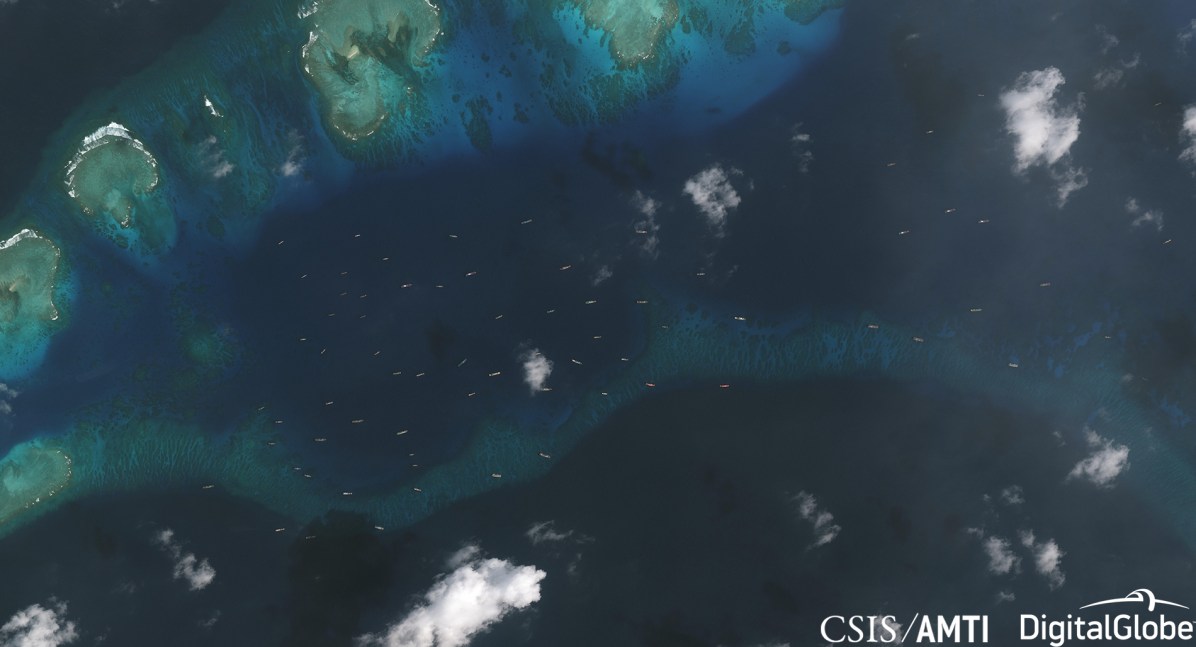
Satellite image shows large Chinese flotilla spotted near Pagasa Island on Dec. 20, 2018. ASIA MARITIME TRANSPARENCY INITIATIVE


MANILA, Philippines — China deployed a large paramilitary force late last year in an apparent response to the  ongoing construction by the Philippines on Pagasa Island (Thitu) in the West Philippine Sea (South China Sea), new satellite images have showed.

"A handful of Chinese vessels have operated in the area between Subi and Thitu since at least July 2018, likely in response to the initial Philippine effort to start runway repairs last May. But their numbers increased to at least 24 on December 3, just before the current construction operations began," the Washington-based think tank Asia Maritime Transparency Initiative said in its latest update on Thursday.

"In five subsequent satellite images captured from mid-December to late January, their numbers fluctuate, reaching a high of 95 on December 20 before dropping to 42 by January 26," it said.

A Dec. 14 satellite image shows a barge anchored off the west coast of Pagasa Island as part of the construction of a beaching ramp./ ASIA MARITIME TRANSPARENCY INITIATIVE

The report said the fishing boats have mostly been anchored between 2 and 5.5 nautical miles west of Pagasa, while the naval and coast guard ships operate slightly farther away to the south and west.

China's 'cabbage strategy'

"This deployment is consistent with prior examples of China's 'cabbage strategy,' which employs concentric layers of fishing, law enforcement, and naval vessels around contested areas," the report said.

An assessment of the AMTI said these vessels are part of China's maritime militia. These vessels do not actually fish but intimidate other claimants in the South China Sea.

Satellite image taken on Dec. 20 show the ships transiting from Zamora Reef to Pagasa Island. CSIS Asia Maritime Transparency Initiative

"The fishing vessels display all the hallmarks of belonging to China's maritime militia, including having no gear in the water that would indicate fishing activity and disabling their Automatic Identification System (AIS) transceivers to hide their activities (for instance, on December 20 only 1 of the 95 or more vessels engaged in the deployment transmitted AIS data)," the report said.

In a satellite image taken Dec. 20, a PLAN Type 053H1G (Jianghu V-class) frigate and a CCG (Chinese Coast Guard) Type 818 (Zhaoduan-class) cutter were seen near Pagasa Island. Philippine Navy frigate BRP Ramon Alcaraz was also spotted southeast of Pagasa, just over 7 nautical miles from the Chinese frigate.

Philippine Navy ship BRP Ramon Alcaraz spotted near Pagasa Island on Dec. 20. CSIS Asia Maritime Transparency Initiative

Satellite images from Jan. 11 showed one PLAN and one CCG ship, likely a Type 056 corvette and a Type 718B cutter near Pagasa. On Jan. 26, only a CCG Type 718B was spotted.

"The drop in the number of government vessels, mirroring the reduction of the militia presence, suggests Chinese forces have settled into a pattern of monitoring and intimidation after their initial large deployment failed to convince Manila to halt construction," the AMTI noted.

Pagasa is the biggest of the nine Philippine-occupied islands in the Spratlys, inhabited by about a hundred civilians and a small batch of troops.

In April 2017, the Philippine government announced that it will repair the runway on Pagasa and construct a beach ramp or a port to allow ships to bring in construction materials for the building and repair of facilities.

'Much less destructive'

The construction of a beaching ramp on Pagasa had been facing delays due to rough seas, Defense Secretary Delfin Lorenzana said earlier this week. It was supposed to be completed in 2018 but it was moved to the first quarter of 2019.

The AMTI first reported the ongoing construction on Pagasa in May 2018. Based on satellite images, the new construction started on mid-December, as no apparent work was ongoing in imagery taken early December.

"Satellite imagery from December 13 and 14, 2018 show a barge anchored off the west coast of the island with excavators and a bulldozer in the process of depositing and grading sand to extend the small existing causeway to the edge of the reef—presumably creating the beaching ramp referred to by Lorenzana," the report said.

A Dec. 14 satellite image shows a barge anchored off the west coast of Pagasa Island as part of the construction of a beaching ramp. CSIS Asia Maritime Transparency Initiative

But the AMTI said the satellite images from Jan. 11 and 26 this year showed that the reclamation work is more than a simple beaching ramp: "Both images are partially obscured by clouds, but they reveal excavators depositing sand over an area of approximately 8 acres, or more than 32,000 square meters, to the north of the existing causeway."

The AMTI said the ongoing reclamation work on Pagasa is "much less environmentally destructive method" than China's massive island-building in the Spratlys and Paracels. It said the Philippines used construction equipment depositing sand shipped in from elsewhere, while China used suction-cutter dredgers to grind up the reef surface and build outposts with the resulting sediment.

Once completed, the AMTI said the Philippines will have created 8 acres of land in the Spratlys, as compared to 120 acres by Vietnam and 3,200 by China.

"Manila appears intent on upgrading its facilities in the Spratlys despite any détente or objections from Beijing. But those plans continue to face delays and their scope is much more modest than those undertaken by China or even Vietnam," the report read.

Other PH facilities in Spratlys

Other Philippine-controlled islands in the Spratlys also continued to see minor upgrades in the latter part of the year. Between May and November 2018, a lighthouse was built on the western shore of Likas (West York) Island, the AMTI said.

The Philippines announced last year that it plans to build five lighthouses in the West Philippine Sea.

Meanwhile, a Philippine flag was also painted on the roof of a shelter built in Kota Island (Loaita Cay) on Dec. 8 last year, as seen on a satellite image.

"Manila isn't the first to use roof art to announce its claims to passing planes and satellites. For years, the Vietnamese flag has decorated a large building on Spratly Island, while an even larger Chinese flag is stamped on Triton Island in the Paracels alongside the characters 祖国万岁 (Long live the motherland)," the AMTI said.  /muf

Read Next

LATEST STORIES

MOST READ

Subscribe to INQUIRER PLUS to get access to The Philippine Daily Inquirer & other 70+ titles, share up to 5 gadgets, listen to the news, download as early as 4am & share articles on social media. Call 896 6000.