"Wanna know how the movie ends?"
The movie in question is next March's Brie Larson-starring Captain Marvel, the centerpiece of Marvel Studios' future and the subject of nuclear-grade global anticipation. Of course, I want to find out how it ends. But that's not going to happen.
The person asking–Ron Richards, VP and managing editor of Marvel's New Media division–is only asking as a joke, the punchline being that I have a better chance of leaving Marvel's offices with a nascent genetic mutation than any juicy tidbits about future films.
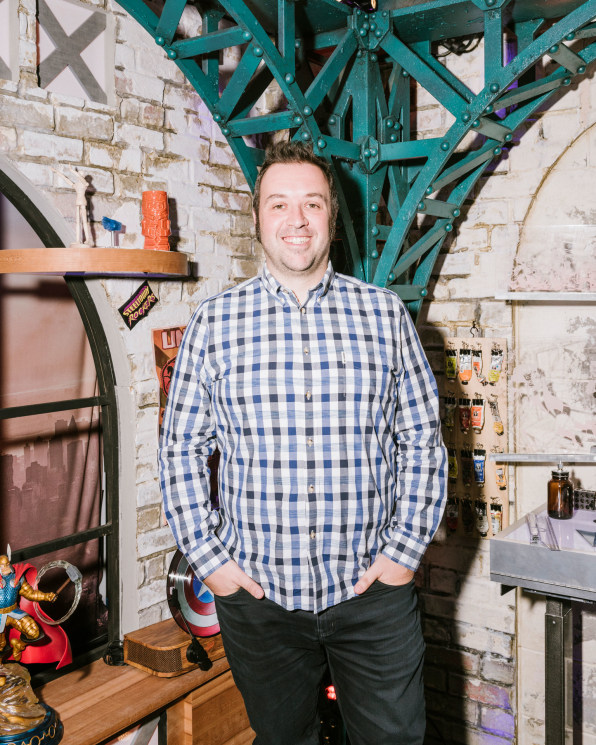
Marvel, which is celebrating its 80th anniversary this year, didn't get to be perhaps the world's top pop culture brand by being sloppy. They know how to keep their information economy on lockdown. The reason I'm here today, touring their offices for Fast Company's Innovation Festival, is because Marvel's efficiency in guarding what they don't want fans to know is rivaled only by its wizardry in offering what they do want fans to know–which is: just about everything.
Over the past 18 months, the company's online presence has transformed from a traditional digital marketing arm for its many distinct forms of content into a true stand-alone business opportunity and an authoritative source for All Things Marvel. The brand's penchant for innovation has already disrupted the comic book industry and the film industry–making interconnected universes the new norm. And now their goal is to be just as disruptive in New Media.
"Marvel as a brand encompasses movies, TV, video games, family content, theme parks, and the comics themselves," says Sarah Amos, VP of development and production management. "New Media is where all of those different lines of business, and the fans that interact with us, converge digitally. We have to make sure we're representing Marvel Entertainment the right way in that space."
The challenge at the dawn of this digital transformation–when the New Media team took over the eighth floor of Marvel's New York City HQ–was to start creating a daily cadence of content, cultivate a digital identity, and bring in revenue independent of other streams. The strategy for fulfilling these goals ultimately involved a flurry of podcasts and streaming video programs, an aggressive social strategy, and a redesigned website. Oh, and it also took roughly 18 months of intense experimentation.
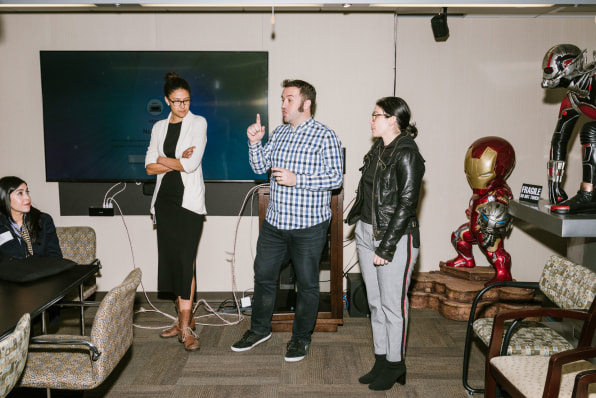
One such video example is Earth's Mightiest Show, whose enthusiastic cohost Lorraine Cink greets us wearing the sweater equivalent of Captain America's shield (at least in terms of color and design, if not indestructibility). Earth's Mightiest Show is a weekly celebration of Marvel fandom and culture, with much-beloved guests like Jessica Jones star Krysten Ritter in tow. Shows like this one and its spin-off, the Marvel-themed cooking show Eat the Universe, are the direct result of the New Media team's willingness to experiment. They cast a wide net when bringing in talent (ETU's Justin Warner comes from the Food Network; Marvel Voices host Angélique Roché is a lawyer who worked for Gloria Steinem) and obsessively monitor the results. The shows are regularly mined for segments that then reappear in Marvel social campaigns.
"We look very closely at performance data, at how audiences react to our shows and how our shows interact with other lines of business," Amos says.
She is particularly fond of post-mortems, conducting exhaustive diagnostic sessions after every new event and product rollout, in search of actionable data. A post-mortem after this past summer's San Diego Comic Con, for instance, led to a completely new distribution strategy for Marvel's live streams at New York Comic Con earlier this month. The latter ended up with a 400% increase over the previous year. (Any other useful learnings from the event will surface at the NYCC post-mortem, scheduled for tomorrow.)

The rapid pace of change–both online, in general, and in the world of comics, specifically–is what brings about a pointed question from one of the tour-goers.
We're visiting with Ryan Penagos, VP and creative executive of New Media and also longtime host of the podcast This Week in Marvel, when an assistant passes each of us a comic book. The woman standing next to me runs her fingers over the glossy cover of the latest issue of Deadpool, an uncertain look on her face, and speaks up.
"This is an embarrassing question, but can you still buy these?" she asks. "I haven't seen one in ages."
Penagos is extremely polite as he recites a list of many remaining sources for physical comic books without betraying how much the question hurts his soul. The question is not entirely without merit, though. It's true that comic books are no longer guaranteed to pop up in every corner 7-11 as they might have in the past. But while the ease of obtaining comic books may have decreased over the years, so has the barrier of entry for new readers interested in poking around that world.
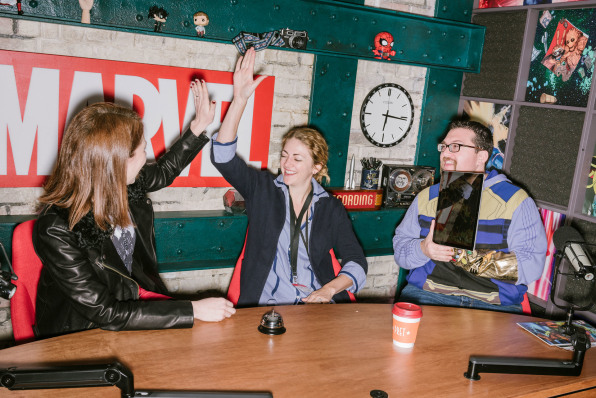
"Part of our job is, we're kind of out there with these huge fishing nets, grabbing what we like to call the Marvel-curious: Fans who have a light understanding of who these characters are," says Ron Richards, who was integral to the website's July redesign launch. "We're looking for how can we grab them with the attention that comes with a new movie and bring them into the Marvel ecosystem and maybe introduce them to Marvel's Spider-Man for PlayStation 4 the Marvel: Contest of Champions mobile game, or our comics, or just content celebrating the Marvel lifestyle."
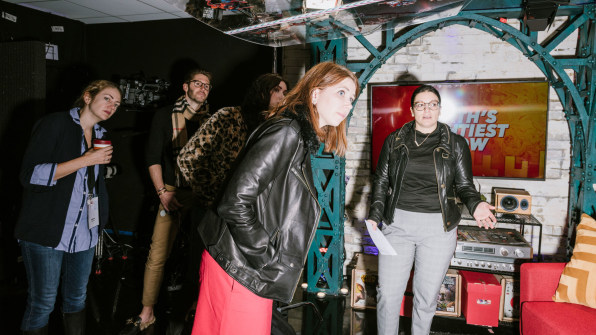
Sarah Amos is very careful with how she answers this question: "We're constantly talking with the Marvel Studios team to make sure that everything they're thinking about and working on is celebrated in the way that it has the potential to be."
The only way I'm getting more information right now is if I suddenly develop mind-reading superpowers, which, given my surroundings, seems at once entirely impossible . . . and also not.