Amazon (AMZN) is much more than the e-commerce company that it was when Jeff Bezos founded it in 1994. It is now a huge company that seems to keep growing every month. With such a big company, Amazon's main focus is growth and diversification, unlike Apple (AAPL) for example. To add to this, Amazon's "main" business may be their retail website, but Amazon's main goal is to diversify and get into every possible market. The reason we bring up Apple is because of the difference between the two tech giants. Apple will acquire to improve their product whereas Amazon will acquire to become a bigger company. Amazon has acquisitions ranging from Whole Foods all the way to Twitch. With such a broad focus, some may wonder what exactly Amazon's goal is. The answer is simple, to be in all consumers hands, any way possible. Amazon's acquisition of Whole Foods was to get into the food industry, products with an expiration date unlike books. Amazon got into Twitch to compete with Google's (GOOGL) YouTube. Although Amazon stock sees a bright future ahead of it, many investors are skeptical. Not only are some investors not buying in but Amazon is also the most shorted U.S. stock. Even though Amazon has investors split on where the future will take the company, Amazon has a bright future and a very profitable one as well.
Major Acquisitions
Part of what has made Amazon the giant that it is today is all of the acquisitions it has made throughout its history. Amazon is a very diverse company now and has added many big companies to its brand in order to better them and Amazon itself. One of the biggest acquisitions that Amazon has made was Whole Foods back in August of 2017 for $13.7 billion. Among many of the reasons that Amazon made this deal was to revamp their Amazon Fresh program. Now, with the Whole Foods brand, Amazon has seen its service 35% in the last four months of 2017, after the deal was made. That is a huge increase and it is thanks to the acquisition of Whole Foods.
Amazon sold a total of $11 million worth of Whole Foods products in 2017, but that isn't nearly as big as companies such as Kroger Co. (KR). Kroger Co. sold nearly $2 billion worth of organic goods in 2017. However, keep in mind that Amazon had only been partnered with Whole Foods for the last quarter of the year. Also, Amazon Fresh sold $135 million in the last four months of 2017 in total, $11 million of which was Whole Foods goods.
Amazon did also sell $2 billion worth of groceries in 2017, but only $350 million through Amazon Fresh; most of the other produce consisted of water, coffee, and Soylent, purchased through Amazon Prime. Amazon has also begun adding non-perishable Whole Foods products to Amazon Prime, such as salsa, pasta, and others.
Currently, only 3% of the $800 billion grocery business is done online, but analysts expect the percent to reach double digits within the next five years. Amazon could see major increases of sales in their online food sales as a result of this growing market. With Whole Foods, a trusted brand name, Amazon could acquire new online customers with relative ease without needing to take them from companies like FreshDirect.
Another reason Amazon bought Whole Foods was the amount of data they receive from it. Before acquiring Whole Foods, they only knew how consumers bought and shopped online, now they are able to collect data on how they shop in actual stores. Overall, Amazon's purchase of Whole Foods was incredibly beneficial for the company and should continue adding to Amazon's grocery profits through both Amazon Fresh and orders of non-perishables on Amazon Prime.
Amazon acquired Twitch in August of 2014 for $970 million. It wasn't a huge platform at the time, YouTube was much bigger and there was no indication of that ever changing. Even two years ago, Twitch didn't seem like it was a huge deal in the online entertainment field. However, it has been gradually growing and when Fortnite skyrocketed in popularity, so did Twitch. This relationship is glaringly apparent, as their number of streamers grew 67% in Q3 of 2017, directly coinciding with Fortnite's popularity.
Twitch makes lots of money, the main principle of the website is that the streamers are supported by their viewers through their paid subscriptions, but so is Twitch. Subscriptions to a streamer cost $5 and Twitch splits that in half with the streamer, these subscriptions only last a month and are purchased as a way for viewers to support their favorite streamers. Donations are another way that viewers support streamers, by just gifting any amount of money to a streamer. However, Twitch doesn't take any cut of this money.
Tyler Blevins, known more commonly as Ninja online, has confirmed that he makes over $500,000 a month, while streaming on Twitch, back in March of 2018. Ever since then, himself and the game have only gotten more popular, and while a good portion of that income is most likely from donations, a large portion is also from subscribers, which Twitch profits from as well.
This is just one man though, and Twitch is reaping the rewards of Fortnite's popularity. Twitch has built a following and many streamers have built a loyal fanbase, so even if/when Fortnite begins to lose its popularity, Twitch should be able to maintain its high numbers as viewers will still watch their favorite streamers, just with new games. Overall, Twitch has skyrocketed in popularity over the past year and should continue to do so, being a very lucrative part of Amazon's ever-growing business.
Amazon's most recent major acquisition was Ring, the smart doorbell company, for $1 billion. Amazon is using this acquisition to try to beat out Google in the connected home race. Amazon is pairing Ring with Alexa which will allow consumers to use voice commands to arm their homes or take videos upon command.
Amazon already has a major leg up on Google in terms of the amount of Amazon Alexa devices sold as opposed to the amount of Google Homes sold, more than doubling Google's numbers. With Ring, it appears as if Amazon will be able to keep its lead on Google to create a full line of products for the connected home.
On top of the connected home advantage, Amazon has had many packages stolen from porches after they were left for delivery, and Ring is a great way to end this problem. There is also some speculation that Amazon will create smart locks under the Ring brand which will allow homeowners to let in plumbers, electricians, etc. after verifying their identity through the Ring app. Ring is also quite a profitable business on its own, even before the Amazon acquisition, and should continue to grow under Amazon's guidance and business expertise.
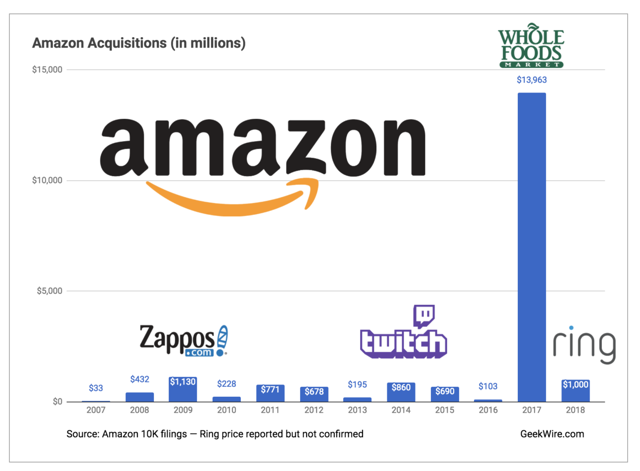
Source: GeekWire (Note that this chart only contains the largest purchase of each given year, not collective totals. Also note that the Twitch figure is $130 million lower than it was in reality.)
Amazon has also made huge strides in creating a strong delivery service for themselves. After announcing in July of 2018 that they were looking to expand their own delivery service, Amazon was flooded with tens of thousands of applicants to deliver for the company. As of now the company only has 5,000 Mercedes-Benz Sprinter vans, but after Amazon received the much higher number of applicants than originally anticipated, they order 20,000 more.
This aggressive and accelerated push for Amazon to be able to rely on their own drivers instead of others is huge for them and cuts out the former middle man, UPS. By delivering their own products, Amazon is able to control the price of shipping and work it to their advantage. With recent news of the USPS, and therefore UPS and FedEx as well, considering to raise their rates for shipping Amazon's packages for them by 9 to 12 percent, Amazon creating their own delivery network is even more necessary. This form of vertical integration will end up proving more lucrative for Amazon because of their ability to dictate how much they need to pay for ground shipping, and where and when they can deliver.
Vans aren't the only thing that Amazon has been building to improve their own delivery service. Amazon currently has 32 Boeing 767 cargo jets which they use to transport products all across the world. To give perspective to this number, UPS currently owns 59 Boeing 767 cargo jets, but Amazon is working on a $1.5 billion international cargo hub that will be capable of storing 100 cargo jets. Upon the completion of both of these projects, Amazon will be more than capable of providing a quick and efficient global delivery service, all without any other companies being needed for assistance. This is important because it further integrates their delivery service, making shipping cheaper for Amazon, as well as allow them to have control over when and how things are shipped.
Amazon's Value
Amazon's biggest value is no longer its e-commerce site as it used to be, now it is all that the company has acquired. What companies such as Alphabet Inc. and Microsoft (OTCPK:MFST) don't seem to get is the importance of diversity, and how important it is. Although Amazon has not acquired as many companies as Alphabet Inc. or Microsoft - Amazon has acquired 85 companies in its history while Alphabet Inc. and Microsoft have both acquired over 200 companies - Amazon is more diverse.
The definition of diverse has nothing to do with quantity and everything to do with variety. That is where Amazon shows off its genius. Companies like Alphabet Inc. and Microsoft have made a lot of acquisitions, but mostly on similar things such as software companies and websites, Alphabet Inc. less so though. However, Amazon does acquire a few of those as well, but they acquire much more in terms of opening themselves to different markets.
The farthest out Google has stepped from something it is comfortable with, like another website or software, was acquiring Nest back in January of 2014, whereas Amazon seems to be comfortable moving into any new industry it wants. What Amazon is able to offer through its diverse network is only going to grow in the coming years as it continues to diversify, but even if they stop all of a sudden, Amazon will still be the leader in diversification of a single company.
Many small companies can also be exciting to investors because of where they might take their company in a couple of years through their growth. The downside of them, however, is that they do tend to have a larger risk factor associated with them than most other companies because their profits are either slow or non-existent.
When people think of growth stocks, Amazon probably doesn't cross their mind. However, it should definitely be considered a growth stock and a big one at that. We consider Amazon the safest and best growth stock on the market. They have so much capital that they can make acquisitions whenever they want, and not worry about going into unrecoverable debt. Although Amazon has the potential to rake in huge profits with their multiple businesses, they forego them in order to further expand their reach by expanding at a rapid rate.
Is There Really An Antitrust Chance?
In the past, there didn't seem to be anybody that would ever dare to consider, or out, Amazon as a monopoly. That was until Lina Khan published "Amazon's Antitrust Paradox" in the Yale Law Journal back in 2017. Ever since then, people have been arguing over whether or not Amazon is in need of an antitrust lawsuit. Lina Khan's main argument against Amazon is that a consensus, reached in the 1970s stating that a company is not a monopoly as long as they do not take advantage of the consumer with overpriced goods, is false.
Amazon had been able to hide behind the agreement for years until Lina Khan challenged it. She argues that the price appeal of goods shouldn't matter, instead what should matter is the inability for other companies to compete with Amazon. Ms. Khan also argues that with monopolies, come a decrease in both variety and quality of goods, which is why antitrust action should be taken against Amazon. However many professionals strongly disagreed with the article published by Ms. Khan.
Herbert Hovenkamp, an expert of antitrust from the University of Pennsylvania Law School, argued that antitrust attacks against Amazon could negatively affect our economy greatly. It still seems unlikely that Amazon will have an antitrust case in their near future, even though Lina Khan got a lot of attention with her paper. As long as Amazon continues to deliver with low prices, they should be in the clear from any antitrust cases.
In addition, while there is no e-commerce site as big as Amazon, there is competition with Amazon in all of other industries that they have become involved in over the years. New e-commerce sites such as Shopify (SHOP) are beginning to emerge as well. This emerging competition on Amazon's strongest front further strengthens Amazon's case against an antitrust lawsuit and makes it increasingly unlikely that they will be trust busted.
Valuation
As we discussed earlier in the article, acquisitions such as Whole Foods, Twitch, Ring, and their ever-growing delivery service is part of what makes the company so successful. However, these acquisitions aren't cheap. Amazon relies on all of their subsidiaries and the original Amazon.com to provide them with the necessary cash to make these acquisitions. Unfortunately, this means that Amazon's profits aren't near what they could be, an insane idea because their profits are already so high, raking in $3.03 billion of net income in 2017. The idea of Amazon's future is something that not many investors have seemed to catch yet but is one that is driving Amazon's business.
Growth has been the mindset throughout the company's life and could remain that way for a while. Like all growth stocks though, expanding their company is their top priority. Once Amazon has decided that it no longer has the need to grow, it becomes a deadly company. Its profits should skyrocket as any successful growth stocks do once they make the transition to a sustainable business plan. This isn't to say that Amazon will no longer spend any capital on expanding, but it will likely soon reach a point where expansion will happen much slower.
In 2017, Amazon generated $117.9 billion of revenue which is a 30.8% rise from the year prior. Amazon also had a gross profit margin of 37.07%, an operating profit margin of 2.31%, and a net profit of 1.71% in 2017. The dramatic drop in Amazon's gross profit margin to operating profit margin should be dramatically reduced as Amazon continues to upgrade their own delivery fleet. Through this, Amazon will dramatically increase their profits. If Amazon completes its fleet and stops acquiring companies at the rapid pace it currently is, they could reach a market cap of 1.4 trillion by 2020.
Overall, Amazon is an incredible company with unrivaled potential. As an investor, purchasing Amazon stock while it is still growing will all but guarantee high rewards. Amazon is incredibly diverse, which allows them to generate all of their revenue, but as they begin reaching a point of relative stability, in terms of acquisitions, their profits will begin to increase at a rapid pace level.
Disclosure: I/we have no positions in any stocks mentioned, and no plans to initiate any positions within the next 72 hours.
I wrote this article myself, and it expresses my own opinions. I am not receiving compensation for it (other than from Seeking Alpha). I have no business relationship with any company whose stock is mentioned in this article.