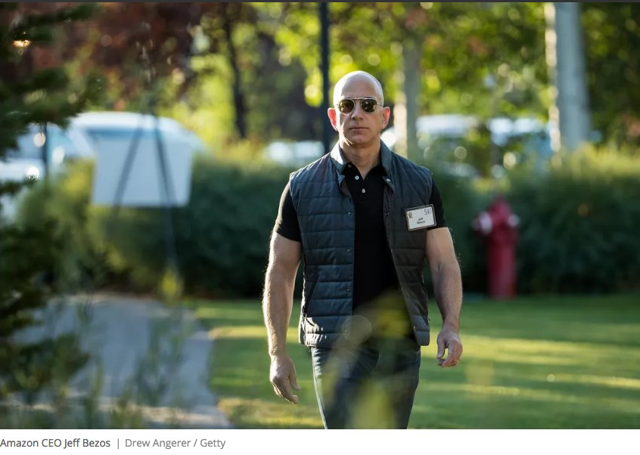
Image via NBC News.
Cover up, cover up, cover up that you're ruthless
Nobody, Nobody, nobody's ever gonna notice
And I am catchin' up and I am seein' red
How about I prove I'm right and raise it overhead?
- Chvrches, "Bury It"
Amazon Acts Against Its Greatest Threat - Again
When news broke last summer that Sears' (SHLD) Kenmore appliances would be sold via Amazon (AMZN), I wrote that Amazon had taken a small step against its greatest threat, which is the prospect of antitrust action against it. Amazon's announcement on Tuesday that it would raise its minimum wage to $15 per hour in the U.S., more than double the federal minimum wage, is a larger step in that direction, as I elaborate below. I close with a look at my site's track record with Amazon,and its current take on it.
The Two Risks On The Horizon For Amazon Shareholders
As I noted back in April of 2017, when I dismissed the idea that Kroger (KR) was a threat to Amazon (this was before Amazon acquired Whole Foods, incidentally), the two main risks I could think of for Amazon shareholders were a broad market correction and political risk in the form of antitrust action against Amazon and other tech oligopolies:
In our view, the two main risks for Amazon shareholders are a broad market correction (or worse) that would suck down Amazon along with other stocks, and political risk. We have no indication either is an immediate risk, but when the New York Times is recycling anti-monopoly cartoons from the trust-busting era in an article about Amazon and the other FANGs, it's something to bear in mind.
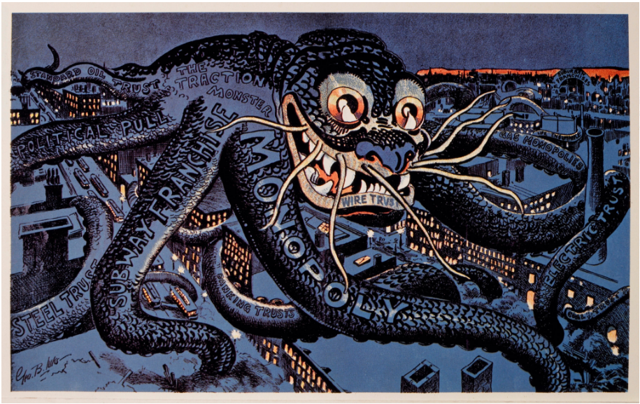
That remains my view, and I still don't have an indication either is an immediate risk. But over the last couple of years, there had been more recent chatter about the market dominance of Amazon and other tech giants getting scrutinized. For example, in July 2017 Bloomberg Technology raised the question of whether Amazon and the other FANG stocks were monopolies:
The rise of global technology superstars like Amazon, Apple (NASDAQ:AAPL), Facebook (NASDAQ:FB) and Google (NASDAQ:GOOG) (NASDAQ:GOOGL) are [sic] creating new challenges for competition watchdogs. Along with Microsoft Corp., they are the five most valuable companies in the U.S. today, a ranking that only included Microsoft 10 years ago. They dominate their markets, from e-books and smartphones to search advertising and social media traffic on mobile devices. This is fueling a global debate over whether it's time to rein in such winner-take-all companies. While the U.S. has been largely hands off, the European Union's recent $2.7 billion fine against Alphabet Inc.'s Google for favoring its shopping-comparison service over rivals' - and the promise of more such actions to come - is cheering those who see pernicious effects from rising concentration. Some officials are even considering novel theories of antitrust, such as privacy issues.
Around the same time, Reuters reported that the ranking Democrat on the House antitrust subcommittee, Congressman David Cicilline of Rhode Island, raised concerns about Amazon's acquisition of Whole Foods, though of course that acquisition ended up sailing through.
At the end of last year, we started to see stories about Amazon employees living in their cars because they couldn't afford rent. This continued over the summer, with the story of a 49-year-old female Amazon employee who claimed she was injured working in an Amazon warehouse and forced to live in her car. What's notable here is that right-wing Breitbart picked up this story from the left-wing Guardian, suggesting that Amazon faced potential pressure from both the populist left and right:
A female Amazon employee was left homeless and living in a warehouse carpark after suffering an injury at a fulfillment center in Haslet, Texas. She says, "I work for the world's richest man and I live in my car."
Vickie Shannon Allen, 49, has documented her eviction from a Texas RV park on YouTube and has also set up a GoFundMe page to try and raise money after losing her home. She has since found a permanent home, but needs money to pay for the first month's rent and the deposit.
"I can't believe this is my life now," she says in one of her videos. "I work for the world's richest man and I live in my car."
As Ms. Allen pointed out above in that excerpt from Breitbart, Amazon CEO Jeff Bezos is the world's richest man, which didn't help the optics. Left-populist Senator Bernie Sanders weighed in against Amazon:
So, by August, the world's richest man's company was under attack by both the populist left and the populist right, in the form of President Trump. Flash forward to October 2nd, and Bernie Sanders was praising Bezos:
And Amazon's pay raise drew praise from President Trump's chief economic advisor, Larry Kudlow, as well:
There are still think tankers like liberal anti-monopoly expert Matt Stoller who are unimpressed.
But on Tuesday Amazon took a big step in cooling concerns about its market dominance by giving hundreds of thousands of employees a big pay raise.
On top of that, it further expanded its moat by making it more expensive for competitors to compete with it for workers.
Our Current Take - And Track - Record On Amazon
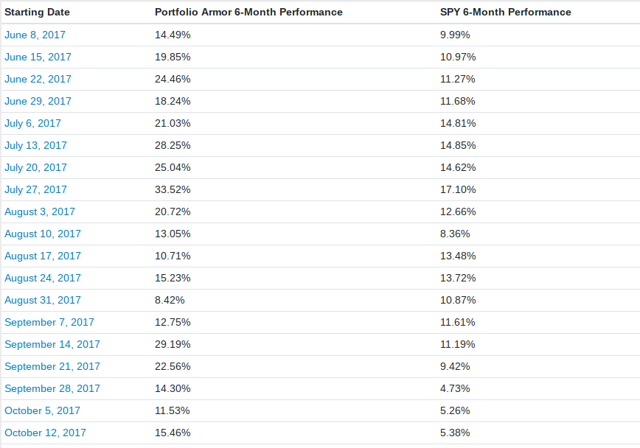
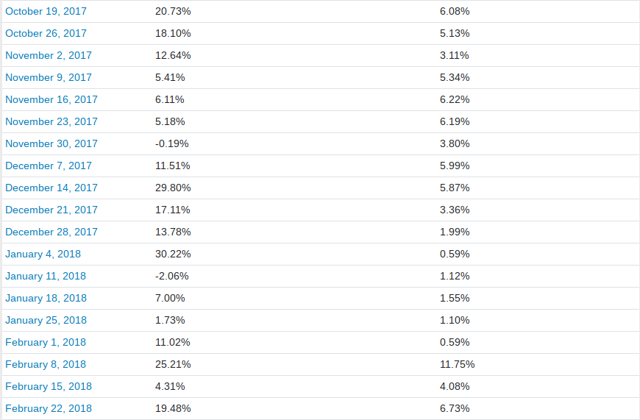
Each week since June 8, 2017, I've been presenting Portfolio Armor's top 10 names in terms of its estimate of their potential returns over the next six months to my Marketplace subscribers.
So far, Amazon has made the weekly top 10 list more than 18 different times this year. It's currently Portfolio Armor's No. 3 name. But it's been a top Portfolio Armor name for years before I began offering my Marketplace service. I gave an example of that in an April article on Assured Guaranty (AGO), which David Einhorn announced he had shorted at the Ira Sohn conference:
One example that comes to mind is an article of mine from a couple of years ago ("Einhorn Shorted Amazon - You Shouldn't"), in which I noted that Amazon was Portfolio Armor's top name at the time, and suggested readers consider buying it, provided they hedged in accordance with their risk tolerance. You can probably guess how Amazon has done since I wrote that article, but if not, here's the chart from YCharts.
There was a dip shortly after I wrote that article, as you can see in the chart above. I wrote a follow-up article then encouraging investors to stay the course.
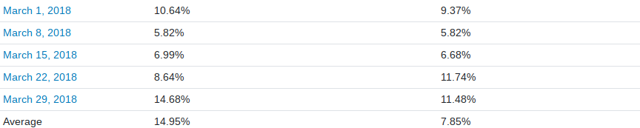
I offered a few more examples of times my site was successfully bullish on Amazon over the years in an article last year ("Forget About Value Investing"). The success with its bullish calls on Amazon hasn't been anomalous. Portfolio Armor's top ten names tend to outperform the market, as you can see in the table below (you can find an interactive version of it, with charts for each weekly cohort, on the Portfolio Armor website).
Wrapping Up
It's hard to find a negative spin on Amazon's big raise. Right now, the only risk I see on the horizon for Amazon shareholders is that of a general market downturn. For readers concerned about that, consider buying umbrellas while it's sunny out.
To be transparent and accountable, I post a performance update for my Bulletproof Investing service every week. Here's the latest one: Performance Update - Week 43.
Disclosure: I/we have no positions in any stocks mentioned, and no plans to initiate any positions within the next 72 hours.
I wrote this article myself, and it expresses my own opinions. I am not receiving compensation for it (other than from Seeking Alpha). I have no business relationship with any company whose stock is mentioned in this article.